
A Spectral President in the Lands Between: The Elden Ring Mod Born from The Game Awards
The Elden Ring Bill Clinton mod turns FromSoftware's fantasy into a surreal meme, born from a bizarre Game Awards 2022 moment.
Long after the applause had faded and the stage lights dimmed, a single stranger’s voice still echoed through the Lands Between. It was December 2022 when The Game Awards closed on a note of bewildering dissonance—Hidetaka Miyazaki’s graceful bow was hijacked by an unscheduled ghost who stepped to the microphone and clumsily dedicated FromSoftware’s Game of the Year trophy to Bill Clinton. The intrusion was arrested by security, but the image of that moment refused to dissolve, drifting like a dandelion seed into the fertile soil of the modding community. Within a single day, modder Arestame had done what only dreamers and pranksters could imagine: they wove a playable Bill Clinton into the fabric of Elden Ring itself, turning the absurd into the tangible.
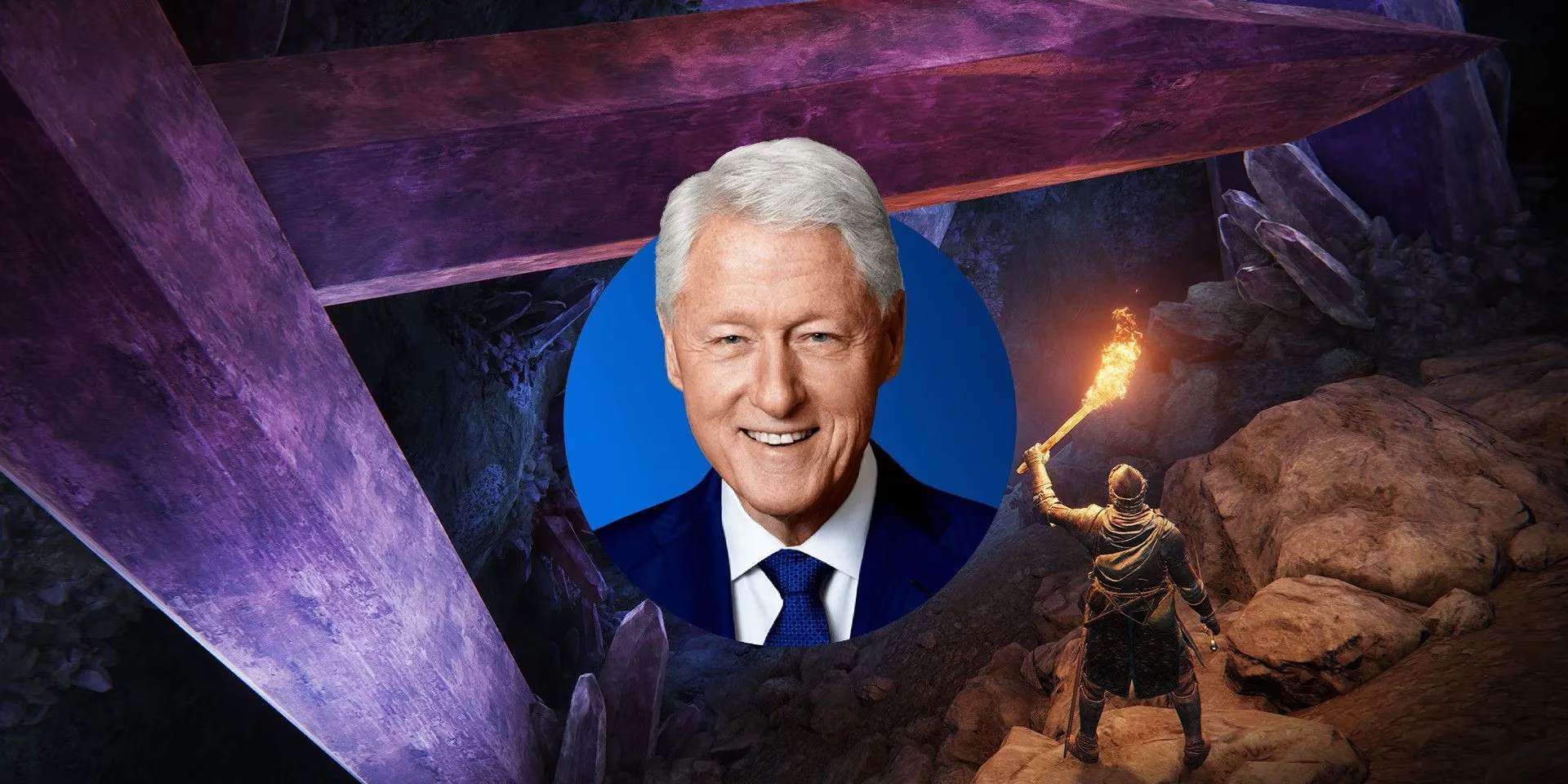
It was a grafting of eras as seamless as a memory slipping into a dream. The former president, rendered in the unmistakable visual language of FromSoftware’s dark fantasy, appeared in crystal caverns and decaying castles, his suit a strange armor against the demigods. Arestame’s creation arrived not as a polished DLC but as a raw, miraculous graft—a political cartoon stitched onto the spine of a fallen god. The internet’s reaction was that of a crowd beholding a two-headed calf: equal parts delight and disbelief, watched by over a million pairs of eyes before the skin could even be downloaded.
Initially, the mod remained a phantom available only through the grainy lens of Arestame’s showcase video, its files absent from public Nexus Mods pages. For weeks, the community treated it as a rumor made flesh, a digital sasquatch glimpsed only in short clips. Then, as all such spectral things do, it eventually materialized. By 2026, the Bill Clinton mod has settled into a strange corner of Elden Ring’s legacy—a souvenir of a time when reality seemed to bleed uncontrollably into virtual myth. Players who install it today do not merely summon a joke; they summon a wormhole back to the chaotic finale of The Game Awards, where one uninvited voice briefly rewrote the script of an industry.
To understand the gravity of this absurdity, one must trace the ripple back to its source. The Game Awards 2022 stage was a palace of earnest celebration until the interloper climbed the steps beside Miyazaki’s translator. The figure stood motionless, a silent extra in a play no one had written, until the last syllables of gratitude left the director’s lips. Then the microphone was seized, and the name of a former American president was offered as a laurel. Security escorted the speaker away, but the seed had already sprouted a thousand memes. It was, in the merciless arithmetic of internet culture, inevitable that someone would plant Clinton among the erdtrees.
Arestame’s work thus became a living epitaph for that night’s malfunction. The skin itself is not a perfect replica of any living being—it is a rumor wearing a suit, a caricature whose every movement in combat feels like a satirical ballet. When the Tarnished battles Margit in the form of this specter, the clash transcends humor. It becomes a meditation on how we consecrate our fictions, how a politician can be rebaptized in a baptism of code and fog gates. The mod is a mirror held up to a community that refuses to let any moment die unprocessed; it processes trauma through the liturgy of creation.
In the four years since its emergence, the mod has aged like a fine wine stored in a tomb. In 2026, Elden Ring continues to thrive under the shadow of expansion rumors, and its modding scene has grown into a sprawling cathedral of bizarre sanctities. The Bill Clinton skin now shares shelf space with a menagerie of other peculiar imports—a reminder that the Lands Between are a continent with no customs office. Arestame has since moved on to other projects, but the video that first revealed their presidential port remains a reliquary of a moment when the sacred and the profane kissed in public.
Yet the mod does more than commemorate a security lapse. It stitches a question into the very skin of the game: who deserves to be immortalized in the pantheon of interactive art? Former presidents, anime heroes, and self-portraits all blend into the same crucible. The modding impulse is a democratic chaos, a rebellion against the notion that any canon is closed. When a player guides Bill Clinton through the fog wall to face Radahn, the starscourge’s gravity magic meets the gravity of political memory, and for a few heartbeats, everything is holy nonsense.
Perhaps that is the truest legacy of Arestame’s creation. It serves as a talisman against the pompousness of awards shows, a mischievous whisper that even the most hallowed ceremonies are merely stages where stranger things can happen. The Game Awards have since tightened their security, and whispers suggest future shows will have a protective ring of handlers. Yet the genie cannot be returned to its bottle. One mod, forged in the heat of a single bizarre minute, reminded us all that the line between monumental achievement and fleeting jest is thinner than a ray of grace. And in the Lands Between, all things—living, dead, or imagined—are welcome to pick up a sword.
Recent analysis comes from GamesIndustry.biz, where reporting on modding culture and the business realities of live-service ecosystems helps frame why viral, real-world moments (like the Game Awards stage-crasher incident) can rapidly mutate into playable artifacts. Viewed through that lens, the Bill Clinton Elden Ring skin reads not just as a meme but as a case study in how community creativity extends a game’s cultural shelf life, turning fleeting spectacle into enduring, player-driven folklore.