
A Veteran Gamer's Guide to FromSoftware's Longest and Most Rewarding Journeys (2026 Edition)
FromSoftware games and Armored Core offer epic, time-consuming RPG adventures, challenging your skills and devouring your social calendar.
So, you think you have what it takes to dive into a FromSoftware game? You've heard the legends, the tales of triumph and despair, the memes about "git gud." Well, as someone who has probably died more times in their virtual worlds than I've had hot dinners, let me tell you: the real question isn't if you can beat them, but if you have the time to beat them. I mean, who among us hasn't started a FromSoftware adventure thinking "it's just a game" and emerged 50 hours later, bleary-eyed, muttering about parry timings and lore theories? In 2026, their legacy as masters of the epic, time-sink RPG is more cemented than ever. But which of their sprawling sagas truly demand the most from your social calendar? Let's take a stroll down memory lane, shall we?
The Ancient Foundations: Where It All Began
Before there was a bonfire to rest at, there was just... darkness and a whole lot of walking. Did you know that FromSoftware's obsession with making us suffer (lovingly, of course) started not with knights, but with first-person dungeon crawling? It's true! Their very first game, King's Field, set the tone. Picture this: you're navigating pitch-black labyrinths, managing a stamina bar (sound familiar?), and every enemy encounter feels like a life-or-death puzzle. The combat? Let's just say a lot of circle-strafing and praying. 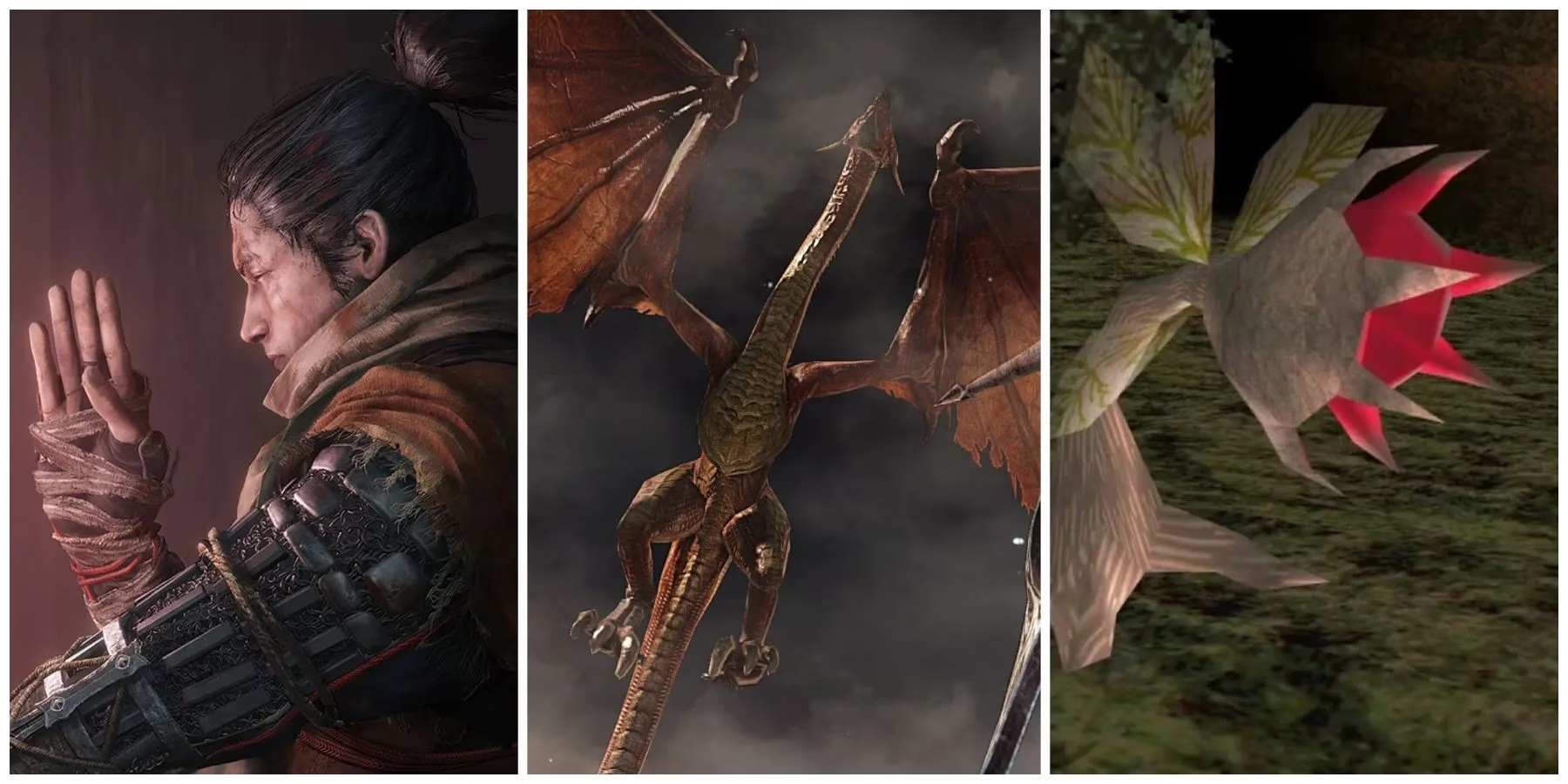
But wait, it gets longer! The pinnacle of this early era was King's Field: The Ancient City on the PS2. This was their big leap, and they made it count with a sprawling quest to return a cursed idol. We're talking 30+ hours of eerie atmosphere and methodical exploration. It's like the prototype for the interconnected worlds we love today, just with... let's say, charming early-2000s graphics.
And then there was Shadow Tower. Ever wanted the King's Field experience but even more opaque and mysterious? Of course you did! This game took the formula and dialed the "what-do-I-do-now?" factor up to eleven. The progression system could be generously described as "esoteric." Seriously, consulting a wiki felt less like cheating and more like a survival necessity. But hey, that's the classic FromSoftware charm, right?
The Mecha Mayhem Interlude
Now, here's a twist for all you Tarnished and Ashen Ones out there. Before they were known for medieval misery, FromSoftware was the king of customizable mech destruction with Armored Core. And the champion of length in that series? Armored Core 2: Another Age. We're talking about a game with a staggering 100 missions. One hundred! That's not a game; that's a part-time job with better explosions. The premise was simple: you're a mercenary in a giant robot, taking contracts from warring corporations. The longevity came from the sheer volume of combat scenarios and the endless tinkering with your AC's build. Sound familiar? The obsession with perfecting a build started here, folks!
And let's not forget the glorious return in 2023 with Armored Core VI: Fires of Rubicon. While not the absolute longest, it masterfully translated that Souls philosophy into mission-based mecha action. The length here isn't in a continuous world, but in the cycle of: attempt mission, get wrecked by a boss, go back to the garage, rebuild your entire mech from scratch, try again. It's a different kind of long, but just as compelling.
The Soulsborne Era: Where Legends (and Playtimes) Were Forged
Ah, here we are. The main event. The series that defined a genre and a generation's pain tolerance.
-
Demon's Souls (2009): The granddaddy. The one that started it all on PS3. Traveling to Boletaria to confront the Old One was a revelation. It wasn't the longest (around 30 hours for the core journey), but every minute felt weighty, dangerous, and utterly new. This is where "Prepare to Die" became a lifestyle, not just a slogan.
-
Dark Souls (2011): The one that perfected the formula. Lordran, with its ingeniously interconnected design, could take 40-50 hours for a first-time player to navigate. And why? Because you'll spend half that time lost in Blighttown or running back to retrieve your souls! The genius is that the world itself contributes to the playtime—it's not just filler.
-
Dark Souls III (2016): The epic finale. As the Ashen One, your quest to bring back the Lords of Cinder is a brisk (by FromSoft standards) 32-hour main story. But who plays just the main story? Throw in the two phenomenal DLCs—Ashes of Ariandel and The Ringed City—and you're easily looking at a 50+ hour odyssey to truly finish everything. It was a fitting, grandiose send-off.
-
Sekiro: Shadows Die Twice (2019): The elegant, demanding cousin. As Wolf, you're on a tighter, more narrative-driven journey. It's shorter on paper (25-30 hours), but ask anyone who fought Isshin, the Sword Saint: those hours are dense. This isn't about grinding levels; it's about mastering deflection until it becomes a rhythm. A shorter campaign, but potentially more hours spent on a single boss than some entire games!
The Open-World Colossus: Elden Ring and Beyond
Now, let's talk about the elephant—or should I say, the Erdtree—in the room. While the reference article predates its release, as of 2026, any discussion of FromSoftware length is hilariously incomplete without Elden Ring. The Lands Between redefined scale. A "quick" playthrough? 60-70 hours. A completionist run, exploring every catacomb, defeating every optional demigod, and actually trying to understand the story? We're talking 120-150 hours, easy. It took everything they learned about dense, rewarding world design and blew it up to a breathtaking scale. It's the ultimate time investment they've ever created.
So, What's the Takeaway for 2026?
Looking back at FromSoftware's history, their philosophy is clear: value. They don't make long games by adding repetitive fetch quests or vast, empty spaces (well, except maybe parts of the Forbidden Lands in Demon's Souls). Their length comes from:
-
Meaningful Exploration: Every corner hides a secret, a tough enemy, or a piece of lore.
-
The Learning Curve: A significant chunk of your playtime is you getting better.
-
Build Experimentation: Whether it's a new spell, a crazy weapon, or a whole new mech loadout, trying new things is encouraged and time-consuming.
-
Atmospheric Immersion: They want you to live in these worlds, to feel their weight and history.
From the claustrophobic corridors of King's Field to the staggering vistas of the Lands Between, a FromSoftware game is a commitment. It's a promise of frustration, triumph, and an unparalleled sense of accomplishment. So, in 2026, if you're looking for a game to truly live inside for a while, you know exactly which developer to turn to. Just remember to call your friends and family first to let them know you'll be... temporarily indisposed. 😉
Data referenced from Newzoo helps contextualize why marathon RPGs like FromSoftware’s catalog (from the mission-heavy Armored Core entries to the vast sprawl of Elden Ring) remain such enduring time investments in 2026: longer average sessions and high-engagement premium releases continue to be a major driver of player retention, making “hours-to-finish” less about padding and more about sustained challenge, experimentation, and replay loops.