
Elden Ring's Unprecedented Triumph: A First-Person Reflection on Becoming the Most Awarded Game
Elden Ring sets a new record for Game of the Year awards, surpassing The Last of Us Part II with critical and fan acclaim.
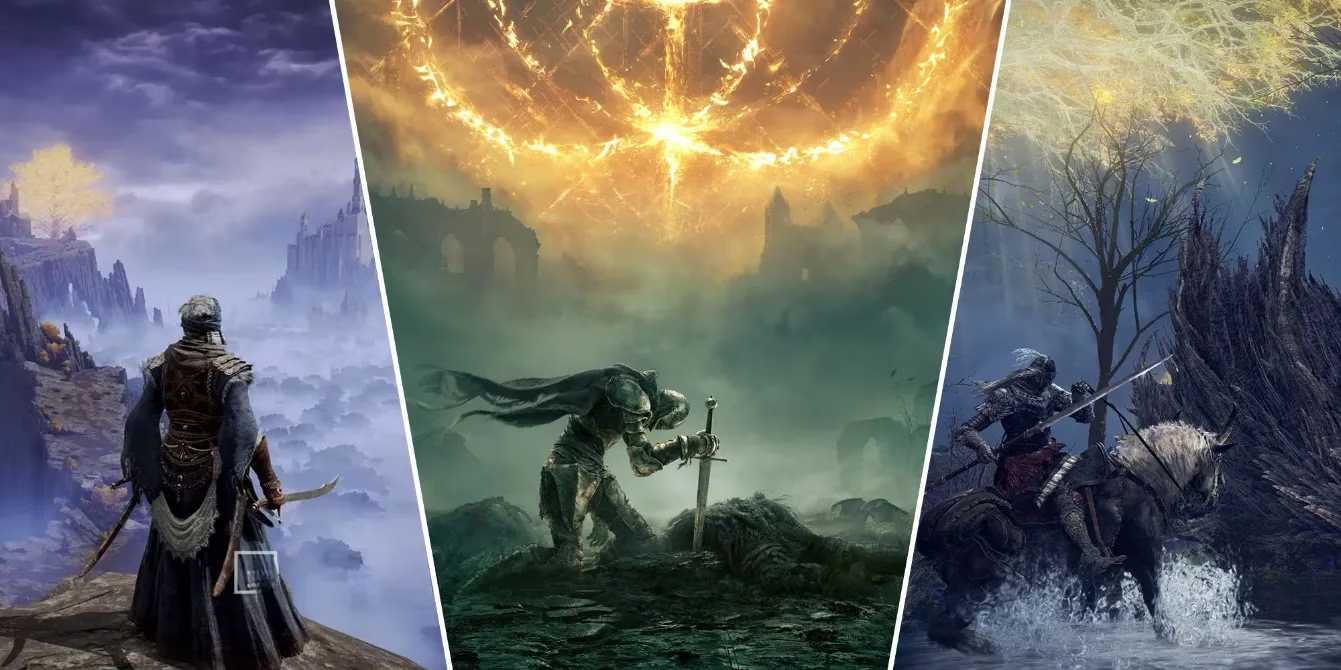
As I look back from the vantage point of 2026, the journey of Elden Ring still feels monumental. It wasn't just a game; it was a cultural reset, a phenomenon that redefined what a blockbuster title could be. I remember the anticipation, the awe upon first stepping into the Lands Between, and the collective shock as it began its relentless sweep of every Game of the Year award in sight. But did anyone truly predict it would dethrone a giant like The Last of Us Part II? According to meticulous trackers on forums like ResetEra, that's precisely what happened. By the end of its award season, Elden Ring had amassed a staggering 324 Game of the Year awards, officially surpassing the previous record of 322 set by Naughty Dog's masterpiece in 2020. This wasn't just a victory; it was a historic takeover.
Dissecting the Anatomy of a Record-Breaking Run
When I delve into the data from that ResetEra analysis, the breakdown is fascinating. It tells a story of near-universal critical acclaim coupled with passionate fan support.
-
Media Dominance: A colossal 281 of those 324 awards came from professional media outlets across the globe. I was among the many journalists and critics who felt compelled to crown it. Publications, big and small, seemed to reach a rare consensus: Elden Ring was a generational achievement in open-world design and atmospheric storytelling.
-
The Voice of the Players: The remaining 43 awards were claimed through "Readers' Choice" or community-voted categories. This dual triumph is crucial. It showed that Elden Ring wasn't just a critic's darling; it resonated deeply with the people who spent hundreds of hours exploring its mysteries. The game bridged a gap that often exists in our industry.
The Landscape of Competition: A Solo Ascent
What makes this record even more impressive is the context of its competition. 2022 was not a weak year by any means. We saw the release of other titans, yet Elden Ring stood alone on the mountaintop.
Consider God of War Ragnarök, a spectacular sequel and one of the biggest PlayStation exclusives ever. Its performance was stellar, but in the head-to-head count for Game of the Year awards, it was no contest. Ragnarök secured a total of 74 awards (60 from media, 14 from readers). Respectable? Absolutely. But compared to Elden Ring's 324, it highlights the sheer scale of FromSoftware's victory. Other notable games from that year, while brilliant in their own right, gathered only a handful of accolades in comparison:
| Game | Game of the Year Awards (Media) | Notable Achievement |
|---|---|---|
| Elden Ring | 324 (281 media, 43 readers) | 🏆 New All-Time Record Holder |
| God of War Ragnarök | 74 | A major critical & commercial hit |
| Immortality | 6 | Acclaimed for its innovative narrative |
| Pentiment | 4 | Celebrated for its historical depth |
| Xenoblade Chronicles 3 | 4 | Praised for its expansive RPG systems |
| A Plague Tale: Requiem | 3 | Admired for its emotional storytelling |
Looking at this table, a question arises: Was the field lacking, or was Elden Ring simply that transformative? From my experience, it was the latter. The game created its own category.
Beyond the Trophies: A Living Legacy
Winning The Game Awards' top prize in December 2022 was a symbolic capstone, but the support from FromSoftware didn't stop there. Even as it celebrated its first birthday, the team was enhancing the experience. I vividly recall the surge of excitement when the free update finally unlocked the long-rumored PvP Colosseums. It was a gift to the community that had already poured so much time into the game, adding a structured, glorious new layer to the multiplayer mayhem. It felt like a statement: this world was meant to evolve and endure.
Now, in 2026, the legacy is clear. That record of 324 awards still stands. It set a new benchmark for success that transcends mere sales figures. It represents a moment where difficulty, opaque lore, and fearless design philosophy were embraced on a global, mainstream level. The journey through the Lands Between wasn't just about becoming the Elden Lord; it was about a game ascending to become the most decorated champion in modern gaming history. And as someone who was there, bearing witness to every step of that ascent, I can say it was a victory thoroughly earned, not just in the critics' circles, but in the heart of the gaming world itself. 🗡️🔥