
Elden Ring: The Board Game – A Tarnished’s Tale Four Years On
Elden Ring: The Board Game and Steamforged Games deliver immersive, diceless combat and punishing Limgrave exploration in tabletop form.
You know that moment when a Kickstarter delivery finally arrives and you’ve completely forgotten you backed it? Yeah, that was me last week when a suspiciously heavy box adorned with a spectral tree showed up at my door. Inside: Elden Ring: The Board Game, the tabletop lovechild of FromSoftware’s agony simulator and Steamforged Games’ knack for turning video game suffering into cardboard therapy. The campaign blew up back in 2022—over £2 million raised in a flash—and here in 2026, my copy has finally earned a permanent spot on the shelf next to my half-painted Dark Souls minis. Let me walk you through what it’s like to go maidenless on a hex grid.
First off, unboxing this beast is a religious experience. The hex tiles slide out with that satisfying new-board-game smell, each one a chunk of Limgrave ready to be explored. The star of the show is the Godrick the Grafted miniature, a chunky boy with more arms than I have patience. He’s sculpted with a level of detail that makes me hear his raspy “I command thee, kneel!” echoing in my head. The map of Limgrave unfurls like a promise of adventure—and a warning that I’ll probably get my Tarnished handed to me before I even find a decent weapon.
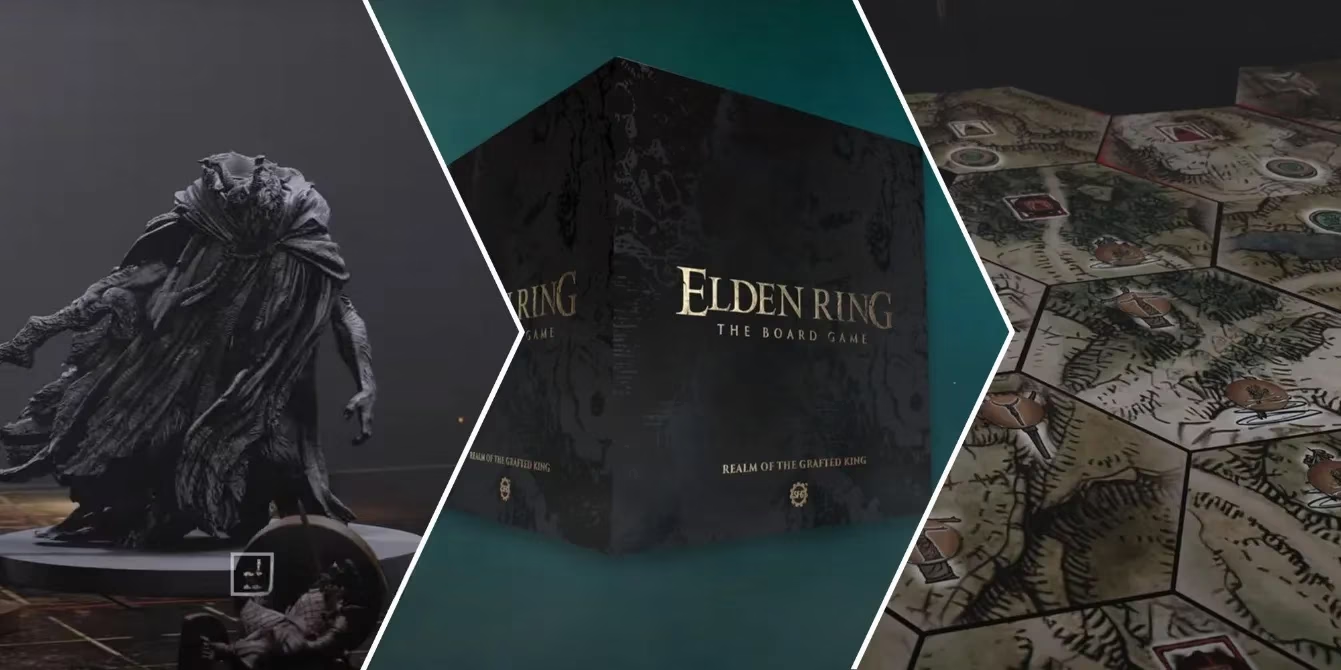
Now, here’s where things get interesting. Steamforged Games didn’t just slap some dice on an Elden Ring theme and call it a day. The combat system is diceless. Not a single cube with pips in sight. Instead, your hand of cards is your stamina. Every swing, dodge, and flask chug is a card you’ll have to sacrifice, and you’d better learn the boss’s attack patterns—yes, they’re AI-driven, just like in the video game, but now they stare at you from a deck of oversized cards. The first time I faced a random Erdtree Burial Watchdog, I burned through my entire hand on a single combo, thinking I was hot stuff. The boss’s next action? A ground-slam that turned my Tarnished into a pancake. I just sat there, cards splayed out like a confessional. “Well, that was educational,” I muttered. That’s the beauty of it: every mistake is a lesson, and every victory tastes like a swig of Crimson Tears.
The overworld exploration is a sandbox of suffering. You build your map tile by tile, uncovering catacombs, merchant stalls, and the occasional tree spirit that makes you regret every life choice. It’s Limgrave in a box—complete with the sense of dread that around the next corner, a grafted monstrosity is waiting to ruin your evening. And the campaign doesn’t stop there. Over the years, expansions have trickled out: Liurnia of the Lakes, Caelid (may the gods have mercy), and most recently, a Leyndell mega-pack that adds seventy new encounter cards and a frankly terrifying Fire Giant. My group started a legacy campaign last month, and we’ve already developed a ritual: before each session, we place a single boiled prawn on the table as an offering to the RNGods. Does it help? Absolutely not. But it’s tradition now.
Steamforged Games, out of Manchester, has a reputation for this kind of thing. They cut their teeth on Dark Souls: The Board Game—another “you died” simulator with plastic bosses—and have since tackled Monster Hunter, Resident Evil, and even a Heroes of Might & Magic III adaptation. But Elden Ring feels like their magnum opus. The card-driven stamina system is a stroke of genius that captures the rhythm of the video game without turning the table into a math exam. You’re not calculating percentages; you’re staring at your dwindling hand, trying to decide whether that extra attack is worth the risk of being defenseless when the boss goes into its next phase. Spoiler: it usually isn’t.
What surprises me most, four years after the Kickstarter, is how the game keeps evolving. The community has cooked up unofficial campaign rules, a hardcore permadeath mode, and even a “Maidenless” solo variant that’s pure punishment. I tried it once. I lasted twelve minutes. The board is now officially mocking me—whenever I walk past the shelf, I swear the Godrick miniature gives me a smug little grin. If you ever find yourself yearning for Lands Between but your PC is on the fritz, this board game will gladly fill that void with about three hours of cooperative despair and one triumphant moment that makes it all worthwhile. Just remember to bring snacks. And maybe a backup Tarnished.