
Elden Ring’s Unstoppable Reign: How FromSoftware’s Masterpiece Reshaped the Industry by 2026
Elden Ring's monumental sales rewrote FromSoftware's legacy and industry expectations for single-player RPGs.
I still remember the electric atmosphere in February 2022 when Elden Ring finally launched. Back then, many of us in the gaming community wondered whether FromSoftware could truly transcend the Soulslike niche and capture a global audience. Four years later, in 2026, the answer is resoundingly clear: not only did Elden Ring shatter every commercial expectation, but it also fundamentally rewired the industry’s understanding of what a single-player, uncompromisingly difficult action RPG can achieve. Reflecting on its journey, I am still awed by the sheer magnitude of its impact—and by the way FromSoftware has leveraged that momentum into a sustained creative and financial powerhouse.
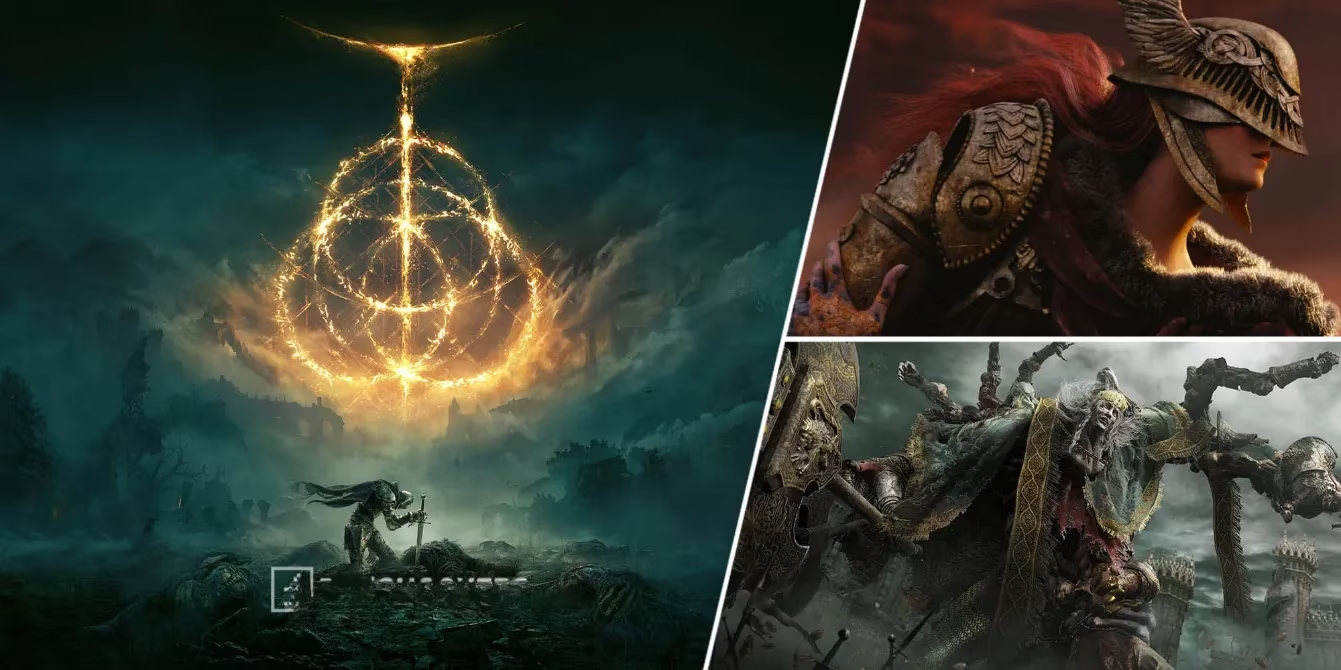
When the first earnings reports rolled in during late 2022, the numbers felt almost fictional. Kadokawa Corporation, FromSoftware’s parent company, revealed that its profits had skyrocketed by over 1,100 percent compared to the previous fiscal year. Operating profit surged to a staggering 7.592 billion yen (roughly $54 million at the time), up from a mere 623 million yen the year before. The catalyst? Elden Ring had sold more than 16 million units within its first nine months—a pace that eclipsed every other title launched in 2022 and turned it into the best-selling game of the year across all platforms. Even as I type this in 2026, those initial figures have only multiplied, with lifetime sales now comfortably exceeding 30 million copies, fueled by deep discounts, word‑of‑mouth, and the blockbuster Shadow of the Erdtree expansion.
What made this triumph even more extraordinary was its endurance. Despite well‑publicised PC performance hiccups at launch—stuttering, frame‑rate dips, and the occasional crash—the game refused to lose its grip on players. For months after release, Elden Ring sat unchallenged atop Steam’s global top‑sellers chart. It turned our collective frustration with technical flaws into a meme‑filled bonding experience, and yet we kept coming back, lured by the Lands Between’s mystifying beauty and the brutal elegance of its combat. How could a title that demanded so much from its audience—patience, pattern recognition, a tolerance for repeated death—dominate a market supposedly craving instant gratification? In my view, it proved that players hunger not just for accessibility, but for worlds that treat them with intelligence and respect.
Financial markets took immediate notice. Less than a year after launch, Bandai Namco, the game’s publisher outside Japan, forecast a 34 percent revenue increase largely attributed to Elden Ring’s ongoing tailwind. More significantly, global entertainment titans Sony and Tencent moved to deepen their ties with FromSoftware. Tencent, through a series of carefully negotiated transactions, now holds 16.25 percent of the Kyoto‑based developer. Rumours of a full‑scale acquisition by either Sony or Tencent have swirled persistently since 2023, fed by Sony’s increased collaboration on exclusivity deals and Tencent’s well‑known appetite for strategic gaming assets. But as I write this in 2026, Kadokawa remains the unmovable majority shareholder, controlling nearly 70 percent of FromSoftware’s shares. Would the conglomerate really relinquish its golden goose? The numbers scream no—Elden Ring alone has generated an unfathomable return on investment, and Kadokawa’s latest financial briefings explicitly label FromSoftware as the pillar of its entertainment division.

That success has not been hoarded as pure profit; it has been aggressively reinvested. In the same 2022 earnings release, Kadokawa stressed that its subsidiary “will continue to invest in the development of more powerful game IP for itself,” signalling that Elden Ring would expand far beyond a single product. And expand it did. By late 2024, Shadow of the Erdtree arrived not as a small DLC but as a near‑sequel‑sized expansion that dominated the Game Awards and once again propelled the base game to the top of sales charts. Hidetaka Miyazaki, the studio’s president and creative visionary, had teased in 2023 that a new title was “in its final stages”—a statement that now, in 2026, has materialised into several projects. FromSoftware has been on a hiring spree, almost doubling its headcount to support multiple concurrent productions, including a new Armored Core entry that defied expectations and an unannounced ARPG that insiders whisper will be even more ambitious than Elden Ring.
Does this mean the studio is abandoning the IP that reshaped its destiny? Far from it. Transmedia expansions are already underway: a tabletop RPG adaptation, a high‑end collectible figure line, and persistent speculation about an animated series produced by a major streaming platform. Kadokawa’s expertise in manga and anime publishing is finally being knitted together with FromSoftware’s dark fantasy universe. This cross‑pollination makes perfect sense when you consider that Elden Ring’s lore—co‑authored by George R.R. Martin—was always cinematic in scope. As a player, I am thrilled to witness the Lands Between burst out of the screen and into other art forms, although I do worry about quality control in a decade obsessed with franchise exploitation.
Reflecting on the past four years, I find it instructive to compare Elden Ring’s trajectory with the rest of the industry. While many publishers continue to push live‑service models and microtransaction‑heavy designs, Elden Ring’s monolithic, one‑time‑purchase structure has proven that premium single‑player experiences can still deliver extraordinary profits. It has also forced competitors to rethink difficulty and player agency. We are now seeing a wave of “Elden‑likes” that blend open‑world exploration with punishing combat—some excellent, many pale imitations—but none have yet captured the same magic.
The numbers remain staggering: Kadokawa’s annual reports for the fiscal year ending March 2026 show that FromSoftware’s segment operating margin is now the highest in the corporation’s history, dwarfing even its traditional publishing divisions. The company has effectively transformed from niche developer into the crown jewel of a media empire. Will the inevitable follow‑up—whether it be Elden Ring 2 or a wholly new I.P.—replicate this feat? I’ve learned never to bet against Miyazaki and his team. They understand that true staying power comes not from chasing trends but from crafting experiences that stay etched in players’ memories long after the credits roll.
As I close this reflection, I recall my own first hours in Limgrave, the sheer terror of the Tree Sentinel, the labyrinthine legacy dungeons, and the unforgettable moment when the map kept expanding beyond any reasonable boundary. That sense of discovery is what I hope the studio preserves forever. In 2026, Elden Ring still feels like a gift to gamers—a work that took everything FromSoftware had learned over two decades and crystallised it into something timeless. And with the studio now flush with resources, talent, and a fanbase eager for more, I have no doubt the best is yet to come.