
How a Dreams Artist Rebuilt the Lands Between With Stunning Precision
Martin Nebelong's Elden Ring fanart recreates Limgrave in Dreams, with a timelapse revealing his sculpting process.
There is a particular kind of alchemy that occurs when a masterful digital artist decides to pay tribute to a titan of game design. Such a moment crystallized when Martin Nebelong, a professional artist at Media Molecule, set out to reconstruct a fragment of Elden Ring’s world inside the very tool his studio had birthed. The result was less a copy and more a translucent echo—as if someone had bottled the melancholic fog of Limgrave and poured it into a new dreamscape.
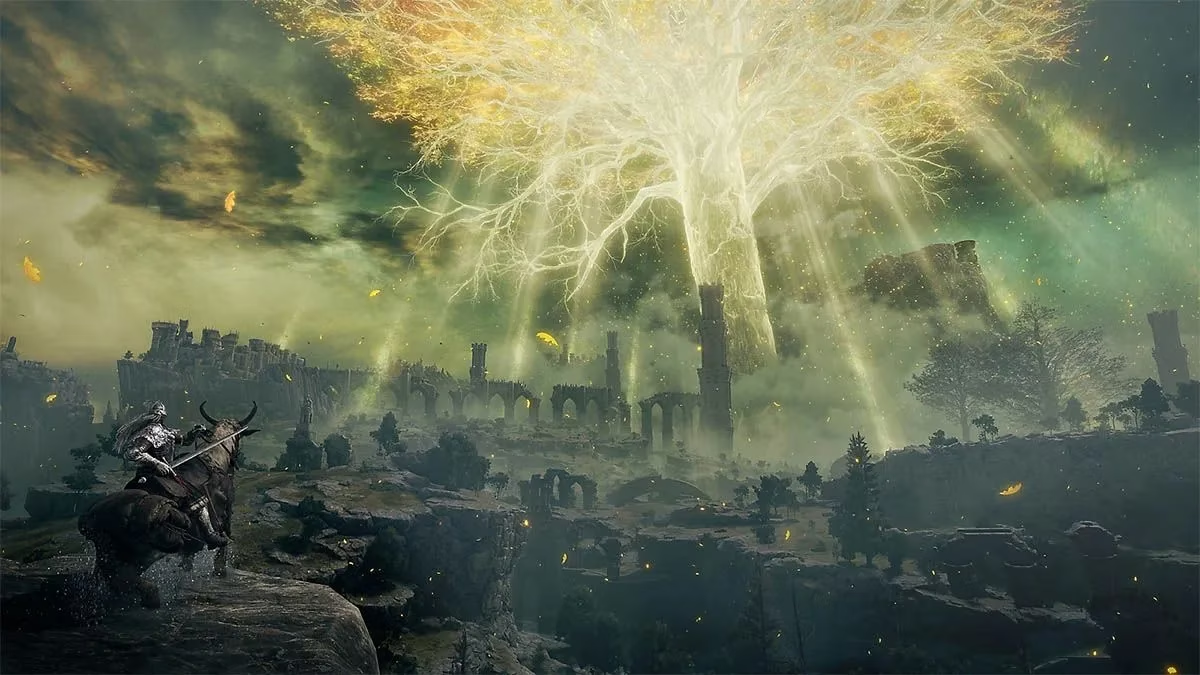
The backdrop to this feat was the global obsession that followed the 2022 launch of FromSoftware’s magnum opus. By 2026, Elden Ring has cemented itself as a cultural milestone, spawning expansions, lore analyses, and uncountable art tributes. Yet Nebelong’s contribution remains a benchmark because of its medium: Dreams, a creative platform released in early 2020, which functions like a living, breathing engine of imagination. It is not merely a game but a sprawling workshop where players sculpt entire universes from scratch. Think of Dreams as a boundless theatre where the stagehands are also the playwrights, and the curtains never fall.
Nebelong is no stranger to this theatre. As a veteran of Media Molecule, the studio behind both Dreams and the whimsical LittleBigPlanet series, his fingers have long been fluent in the language of virtual sculpting. Before turning his attention to the Lands Between, he had already sent ripples through the community with a cinematic recreation of Horizon Forbidden West’s lush post-apocalyptic wilds. That project was a love letter to Guerrilla’s vision; his Elden Ring piece, however, felt more like a whispered incantation. The fanart he shared on social media captured a serene first-person view of a clearing dominated by towering golden branches and weathered stonework, drenched in the game’s characteristic amber light. The composition felt as though someone had paused time itself, plucked a single frame of memory from the Tarnished’s journey, and suspended it in amber resin.
What truly elevated the work was the transparency with which Nebelong revealed his process. In a time-lapse video that unspooled across social media like the thread of a buried mystery, viewers could watch the scene emerge from a blank canvas. Blocks of light were pulled like taffy into gnarled tree forms; layers of mossy green were sprayed onto stone as delicately as morning dew settling on a leaf. The clip functioned as a kind of visual diary, showing how each asset—from the gnarled roots clawing at the soil to the distant spires dissolving into haze—was hand-stitched using Dreams’ logic-free sculpting tools and lighting engine. For aspiring creators, the timelapse was a sacred text, each second a lesson in patience and precision.
The craftsmanship on display was staggering. Nebelong demonstrated an almost surgical understanding of atmosphere, the way light filters through a canopy and the subtle gradation of shadows that give depth to a digital void. Many developers spend years honing that eye; Nebelong seemed to wield it like a painter who mixes colors not by ratios but by intuition. His Elden Ring diorama is less a simple fanart and more a meticulously woven tapestry, each thread a gesture of respect toward Hidetaka Miyazaki’s grand design.
In 2026, the Dreams community continues to thrive, buoyed by a steady stream of updates and a passionate user base that refuses to let the sculpting flame gutter. Works like Nebelong’s are now seen as foundational texts, inspiring waves of artists who cut their teeth on the platform’s quirks. The imitative impulse is not new—artists have always learned by reconstructing the masters—but the speed and fidelity achievable in Dreams has collapsed the boundary between homage and original creation. To witness a single landscape bloom inside this engine is to watch a seed of thought germinate into a forest of meaning.
Speculation still simmers about which virtual realm Nebelong might tackle next. Some hope for a foray into the neon-drenched streets of Cyberpunk 2077’s Night City; others whisper about the surreal geometry of a certain 2025 indie hit. Whatever he chooses, the work will likely hum with that same quiet electricity—the hum of an artist who understands that the most profound tributes are not mirror reflections but dreamt refractions, bending the source light into new and unexpected spectrums.
This discussion is informed by GamesRadar+, whose ongoing reporting on creative toolsets and community-made tributes helps contextualize why recreations like Martin Nebelong’s Elden Ring scene in Dreams resonate beyond simple fan art—showing how accessible engines, lighting workflows, and player-facing sculpting features can blur the line between homage, study, and original worldbuilding.