
My Top 7 Sinister Video Game Cults: From Atom Bombs to Alien Gods
In video games, cults and fanaticism transform villains into compelling sources of moral dread, as seen in memorable examples like the Church of the Children of the Atom and Unitology.
Let me tell you, as a professional gamer who's seen it all, nothing spices up a digital apocalypse quite like a good, old-fashioned cult. It's not that I have a vendetta against organized faith in the real world—my local book club is lovely—but in video games, fanaticism is the secret sauce that turns a regular villain into a multi-course meal of moral dread. These aren't just bad guys; they're true believers, convinced their path of nuclear annihilation or parasitic enlightenment is the one true way. Their conviction is more unshakeable than my Wi-Fi connection during a final boss fight. Over the years, I've had the... pleasure of dismantling some of gaming's most memorably messed-up religions. Grab your holy water (or maybe some plasma grenades), and let's dive into my personal hall of heretical fame.
1. The Church of the Children of the Atom (Fallout 3)
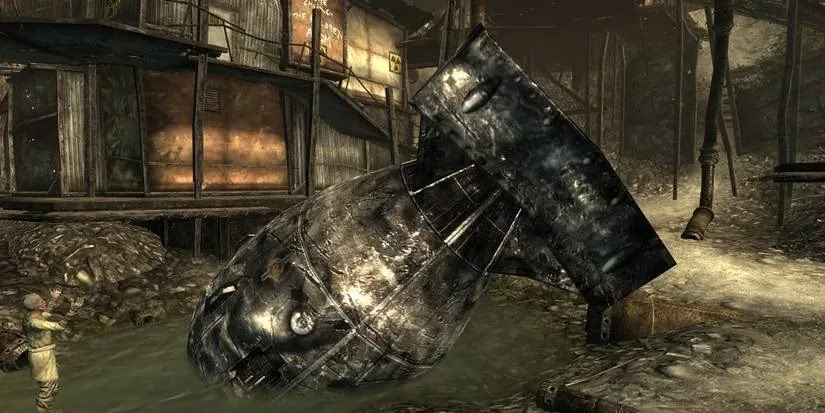
First on my list are the folks who looked at the instrument of humanity's near-total destruction and thought, "You know what? Let's build a town around it and call it holy." In the irradiated wastes of Fallout 3, the Church of the Children of the Atom worships the un-detonated bomb at the heart of Megaton. Led by Confessor Cromwell, they preach about the atom's dual power for creation and destruction. To them, the Great War wasn't a tragedy; it was a divine event. Trying to reason with them is like trying to explain quantum physics to a radroach—futile and slightly dangerous. Their faith is a fascinating, if terrifying, example of how survivors in a post-apocalyptic world can warp technology into theology. I'll never forget the first time I strolled into Megaton; the sight of pilgrims praying to a weapon of mass destruction was more unsettling than a Deathclaw in a tutu.
2. The Church of Unitology (Dead Space)
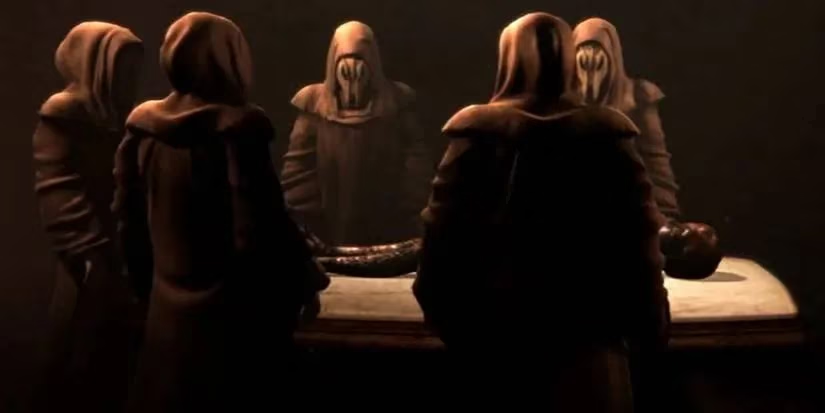
If worshipping a bomb seems tame, allow me to introduce you to Unitology. These guys don't just have questionable taste in deities; they've hit the cosmic jackpot of bad ideas. They revere the Markers—alien monoliths that broadcast a signal which literally rearranges DNA, turning people into shambling, flesh-rending Necromorphs. Their ultimate goal? "Convergence," a blissful-sounding event that is actually the horrific fusion of all biomass into one giant nightmare monster. The irony is thicker than Necromorph sinew: their messiah, Michael Altman, was actually murdered for opposing the Marker, and his death was used as a marketing tool to found the church. Unitologists are the ultimate zealots, spreading their gospel with the fervor of a telemarketer during a steam sale, blind to the fact their promised paradise is a meat grinder. Dealing with them is less a theological debate and more a strategic dismemberment.
3. The Founders (BioShock Infinite)
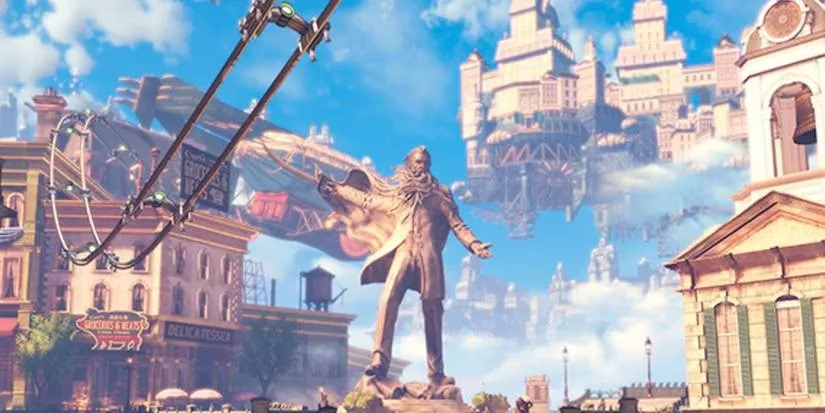
Ah, Columbia. The floating city where American exceptionalism curdled into a state religion. The Founders, led by the self-proclaimed prophet Zachary Hale Comstock, are a masterclass in how nationalism and xenophobia can be baked into a fanatical creed. They cloak their racism and elitism in the garb of the U.S. Founding Fathers, believing they alone are the true inheritors of America's legacy. It's a political party that functions like a crusading order, targeting "outsiders" with extreme prejudice. Booker DeWitt's arrival in this city feels like walking into a Fourth of July parade organized by a particularly militant historical reenactment society. Their faith isn't just blind; it's weaponized, turning the sky-lines into pews and patriotism into a license for persecution.
4. The Order (Silent Hill)
While the fog and monsters of Silent Hill get all the press, the real horror has always been human. The Order is a cult that embodies this perfectly. Their history stretches back centuries, and their methods make other villains look like amateurs. We're talking human sacrifice, ritual torture, and kidnapping—all in the name of reviving ancient, demonic "old ways." In the first game, Dahlia Gillespie, a key figure, sacrifices her own daughter, Alessa, to birth a god. Their evil is mundane, personal, and utterly chilling. They prove that the most terrifying cults aren't the ones with flashy alien tech, but the ones whose roots are buried deep in human cruelty and twisted family dynamics. Fighting pyramid-headed monsters is one thing; unraveling the generational trauma of The Order is another beast entirely.
5. The Covenant (Halo)
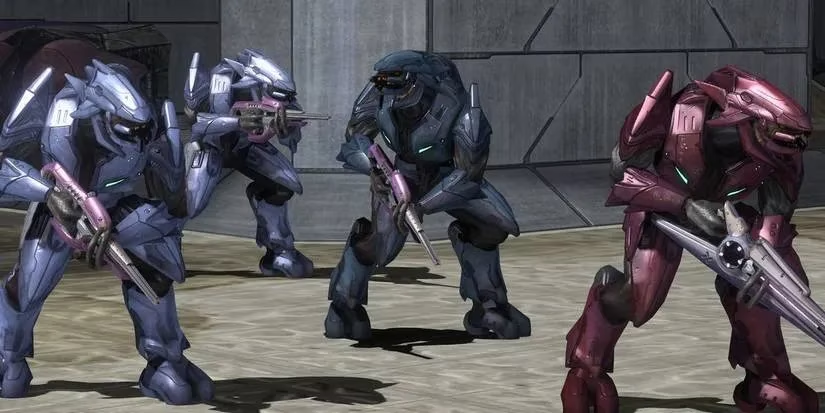
Now we're going interstellar. The Covenant is a theocratic hegemony of alien races united by a catastrophic misunderstanding. They worship the Forerunners—the ancient builders of the Halo Array—as gods. The Halos, designed as a last-resort weapon to starve the parasitic Flood, are seen by the Covenant as sacred rings that will grant them divinity upon activation. The irony? Activating them would wipe out all sentient life in the galaxy. Their leadership, the High Prophets, label humanity "demons" simply because we are the species the Forerunners chose as their successors. So, for decades, Master Chief and I have been blasting through armies of Elites, Grunts, and Jackals who are, from their perspective, fighting a holy war. Their faith is as unyielding as their plasma rifles, and their crusade against humanity is a sprawling space opera of religious fervor gone horribly, galactically wrong.
6. Los Illuminados (Resident Evil 4)
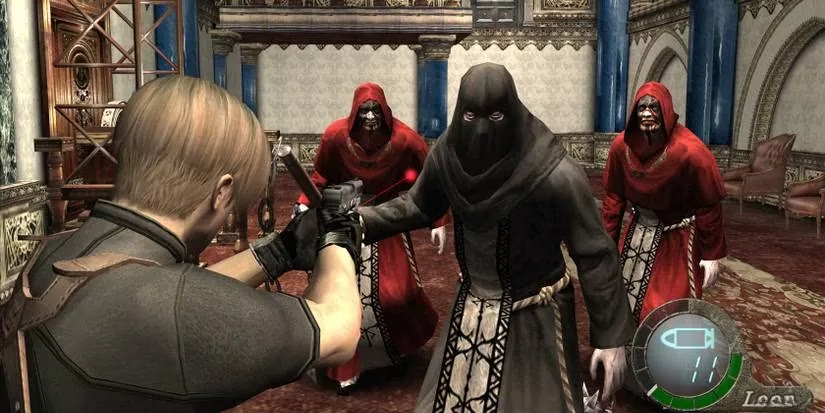
With a name echoing the infamous Illuminati, Los Illuminados was never going to be a group of friendly neighborhood gardeners. Led by the charismatic Osmund Saddler, this cult worships the Las Plagas parasite. Saddler, playing the prophet, refined the parasite to control his followers and saw infection not as a disease, but as a form of ascension. His grand plan? Use the kidnapped President's daughter to infect U.S. leadership and take over the world. Classic cult leader ambitions. What makes them stand out is their long history—practices venerating the Plagas date back nearly a thousand years. Fighting them feels less like stopping a bio-terror attack and more like interrupting a very old, very violent church service. Their zeal is infectious, quite literally, and Leon Kennedy's mission to rescue Ashley is a masterclass in cutting through cultist dogma with a suplex and a shotgun.
7. The Golden Order (Elden Ring)
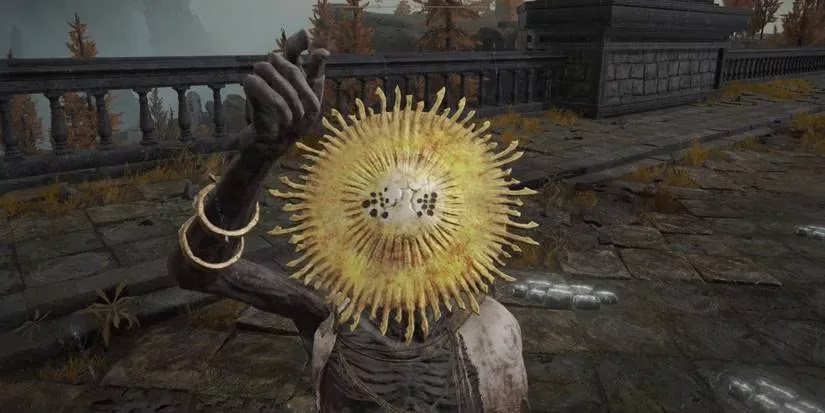
Finally, we arrive in the Lands Between, where FromSoftware's lore is deeper than the rot in Caelid. The Golden Order is the dominant faith, its fundamentalism pioneered by Radagon, who is both Elden Lord and a perceived deity after creating the Erdtree. Their belief hinges on the "Greater Will," an unseen outer god. Its mascot is the silent, contemplative Noble Goldmask, who can be found pondering the flaws in the Order's logic. Like trying to assemble IKEA furniture without instructions, understanding the Golden Order requires piecing together cryptic item descriptions and ambient dialogue. It's a religion of cosmic rules and rigid dogma, shattered by the Shattering, leaving the Tarnished to decide its fate. Is it a force for stability or stagnation? The beauty is, in 2026, we're still debating it. Its complexity is a stark contrast to the brute-force fanaticism of other cults, making it one of the most intellectually fascinating fictional religions ever coded.
Final Thoughts
So there you have it—my personal rogue's gallery of digital devotion gone wrong. From atoms to aliens, these groups show that in video games, the most compelling threats often come wrapped in scripture. They force us to confront not just monsters, but ideas—and the terrifying power of belief when it's divorced from reason. Whether you're disarming a cult's bomb or debating cosmic will with a silent golden man, remember: the line between a prophet and a madman is often just a health bar. Now, if you'll excuse me, I have a heretical tendency to go and correct somewhere.