
The Unforgiving Reality: Why Elden Ring's Lack of a Pause Button Remains a Colossal 2026 Gaming Tragedy
Elden Ring's lack of a pause button transforms this breathtaking adventure into a stressful ordeal for modern gamers, demanding relentless focus.
In the sprawling, breathtaking, and utterly merciless world of Elden Ring, death comes in many forms. It can be delivered by a colossal, fire-breathing dragon guarding a crumbling bridge, or by a grotesque, multi-armed monstrosity lurking in a cursed catacomb. But for a significant portion of the Tarnished, the most frequent and infuriating cause of death isn't found in The Lands Between at all—it's the piercing cry of a baby monitor, the insistent chime of a doorbell, or the sudden realization that the oven timer has been shrieking for the last two minutes. This is the brutal, unspoken truth for countless gamers in 2026: Elden Ring, FromSoftware's magnum opus, remains a masterpiece that life itself prevents them from fully experiencing, all because of one seemingly simple omission—a pause button.
Imagine this: after a grueling day, you finally have a precious hour to yourself. The stars of the Erdtree are your only companions as you navigate a treacherous cliffside, your heart pounding as you inch toward a hidden cave rumored to hold a legendary weapon. The tension is palpable. And then... BEEP BEEP BEEP. Reality comes crashing down. Is it a delivery? A forgotten chore? A child's nightmare? In any other game, you'd hit pause, handle the intrusion, and return to your adventure. In Elden Ring, you have two choices: ignore the real world and likely die in-game from distraction, or put down the controller and accept that your character will be slaughtered by the nearest wandering noble. It's a lose-lose scenario that transforms leisure into a source of stress. How can a game be considered fully accessible when it demands an uninterrupted monastic focus that modern life simply does not allow?
The consequences are dire and quantifiable. Progress isn't just halted; it's actively reversed. Two minor interruptions in a row can result in the permanent loss of tens of thousands of hard-earned runes, resetting hours of grinding toward that crucial next level. The experience becomes a punishing cycle:
-
The Grind: Spend 45 minutes cautiously farming runes from lesser enemies.
-
The Goal: Finally accumulate enough to level up a key stat.
-
The Interruption: A real-life event demands attention for 30 seconds.
-
The Catastrophe: Return to find your character dead, all runes gone, and your progress obliterated.
This isn't difficulty; this is friction of the most frustrating kind. It forces players to choose between their digital journey and their tangible responsibilities. Boss fights, already legendary for their challenge, become exercises in anxiety, not skill. The fear isn't just of the boss's next attack, but of the outside world's next interruption. Is this truly the immersive experience the developers intended? Is the pinnacle of realism being defeated not by Malenia, Blade of Miquella, but by a spam caller?
Let's dismantle the sacred arguments against pausing, shall we? 🛡️⚔️
Argument 1: "It Breaks Immersion!"
Proponents claim that being able to stop time shatters the carefully crafted tension and realism. But what is more immersion-breaking? A brief, static menu screen, or the soul-crushing experience of watching your character die because you had to answer the door for a parcel? The current system forces a far greater break in immersion by yanking the player out of the fantasy entirely and into a state of frustration and loss. A simple, functional pause menu that only allows saving, quitting, or accessing system settings would preserve the in-game tension while respecting the player's time and reality.
Argument 2: "It Makes the Game Too Easy!"
This argument is, frankly, baffling in 2026. A pause button that doesn't allow item use, healing, or strategy consulting does not alter the game's mechanical difficulty one iota. Margit the Fell Omen's combos are just as deadly whether the game is paused or not. The skill required to dodge, parry, and strike remains unchanged. The only thing it changes is the player's ability to manage their life alongside the game. Those worried about players "cheating" by pausing to look up guides mid-fight are policing an experience that has no bearing on their own. The true difficulty should come from the game's design, not from the player's inability to attend to a boiling kettle.
The benefits of a well-implemented pause system extend far beyond mere convenience. It would be the gateway to features the community has begged for:
-
Official Photo Mode: Elden Ring's world is a visual masterpiece. From the haunting beauty of Liurnia's lakes to the cosmic horror of the Eternal Cities, the game is filled with screenshot-worthy moments. A pause menu could seamlessly integrate a Photo Mode, allowing players to freeze time, adjust angles, and capture the grandeur without fear of a Runebear sneaking up on them. This isn't a trivial feature; it's free marketing, community engagement, and artistic expression rolled into one.
-
Accessibility and Inclusivity: Gaming demographics have expanded. Players are parents, caregivers, and professionals with fragmented schedules. A pause function is a basic tenet of accessibility, allowing a broader audience to engage with the game on their own terms. Denying this is to gatekeep a cultural phenomenon from those who cannot dedicate uninterrupted three-hour blocks to play.
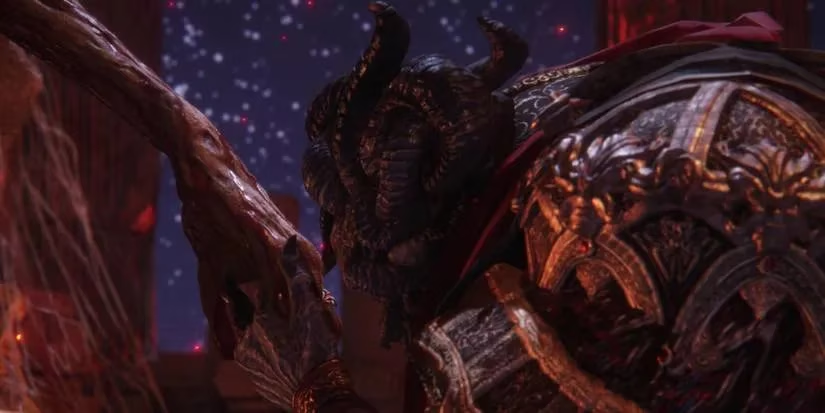
The release of the Shadow of the Erdtree DLC was a monumental event, expanding the lore and challenges of The Lands Between. Yet, for many, its new narratives, bosses, and weapons remain locked away behind an invisible wall—not of skill, but of time and circumstance. The discourse from 2023 has only grown louder by 2026. The community is not asking for easy mode; they are asking for a modicum of control over their interaction with an otherwise flawless virtual world. They want to marvel at the story of Miquella and Mohg, to test their mettle against new, nightmarish bosses, but they cannot do so when the game refuses to acknowledge the existence of the real world.
The tragedy is palpable. Here sits one of the most acclaimed, expansive, and beautiful games of the decade, and a simple quality-of-life feature could open its gates to millions more. The argument that "it's not the Soulsborne way" feels increasingly archaic. Traditions can evolve without sacrificing their soul. The core loop of exploration, brutal combat, and triumphant victory would remain utterly intact. All that would change is the removal of an artificial, external pressure that has nothing to do with gameplay. In 2026, as our lives become more interconnected and demanding, shouldn't our games offer us an escape on our terms, not punish us for living them? The Lands Between is waiting, but for many, it will remain a dream forever paused by reality.