
The Unlikely Harmony: How Taylor Swift's 'Ivy' Sparked My Favorite Elden Ring Theory
Discover how the imaginative Elden Ring community weaves Taylor Swift's 'Ivy' lyrics into game lore for a wildly entertaining theory.
As someone who finds joy in both the punishing landscapes of the Lands Between and the poetic storytelling of Taylor Swift, I was utterly captivated when I stumbled upon a theory that merged these two seemingly disparate worlds. The latest speculation floating around the Elden Ring community doesn't concern some hidden boss or a secret ending—it revolves around the lyrics to Taylor Swift's profoundly underrated song "Ivy," a track from the equally overlooked Evermore album. "Ivy" happens to be my favorite song on my favorite album by my favorite artist, so naturally, my curiosity was instantly piqued. Like most theories shared on the Elden Ring subreddit, it is, by its own admission, complete and utter nonsense. Yet, it perfectly encapsulates the collective personality of this fanbase, which has always been my favorite aspect of being part of this community. This delightful piece of absurdity only deepened my affection for the creative, often hilarious, minds that gather here.
The theory, masterminded by a user known as u/Jiatao24, posits a surprisingly intricate narrative. It suggests that the "Ivy" climbing the walls in the song is a direct reference to the weed-strewn, dilapidated Church of Elleh, the first major site of grace many Tarnished encounter. The opening verse's mention of an "incandescent glow" and the use of the word "tarnished" are interpreted as pointing to the fateful meeting with the enigmatic witch Ranni at the Guidance of Grace within that very same church. 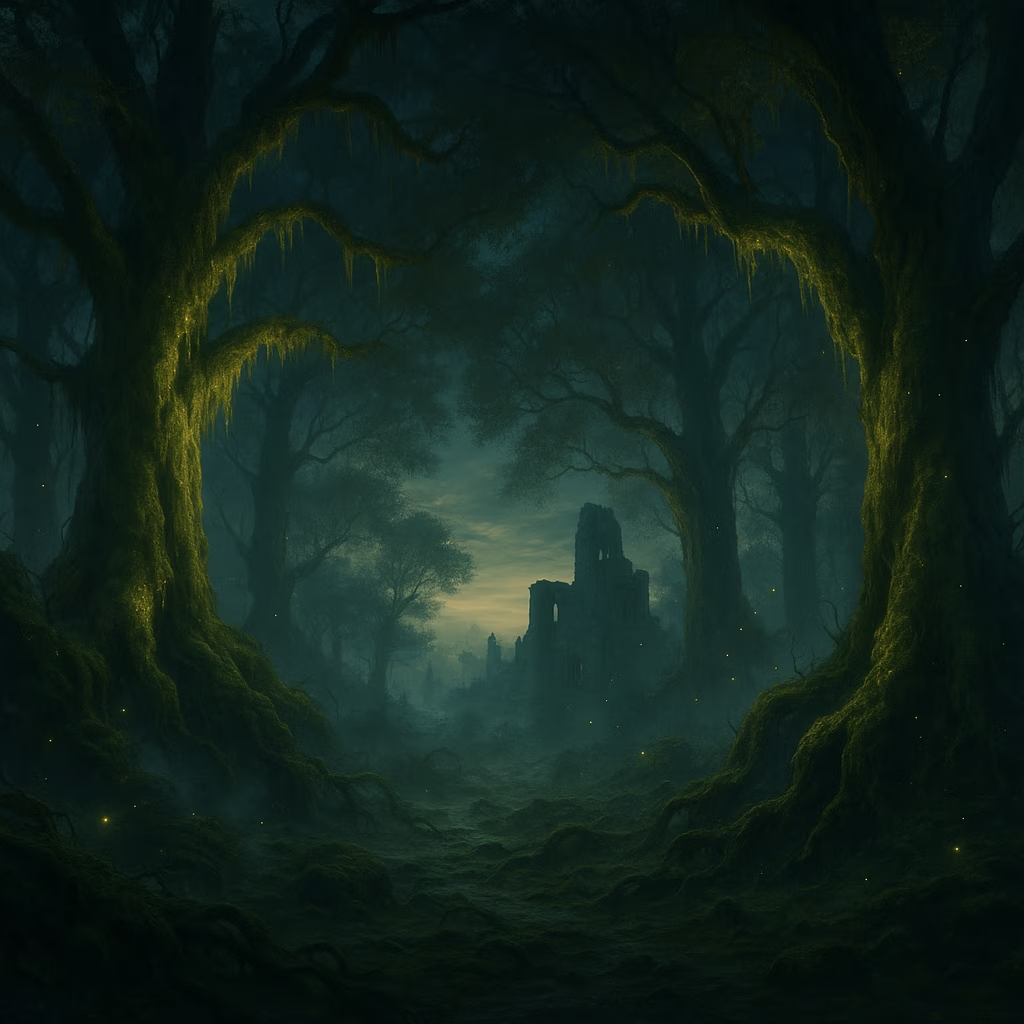 The analysis doesn't stop there; it spirals wonderfully out of control. Other lyrics are alleged to allude to Vyke's tragic fate at the Mountaintop of the Giants, the haunting depths of Deeproot Depths, and the all-consuming Frenzied Flame, weaving a tragic romance between Vyke and Ranni that the game itself never explicitly tells.
Then, in a quintessential display of Swiftie-level detective work, the theory pivots from storytelling to prophecy. Given Taylor Swift's notorious reputation for embedding Easter eggs in her lyrics, the theorist claims the line "spring breaks loose" hints at the vernal equinox. This is supposedly backed by the song's title—"Ivy" becoming the Roman numeral "IV," which becomes the number 4—suggesting a launch in the early to mid-point of the year's fourth month. By sprinkling in some additional Swiftie lore about significant dates, the theory arrives at a very specific, and entirely fabricated, release date: April 13, 2024, for the Shadows of the Erdtree DLC. The joke, of course, is that this date was "confirmed" by Taylor Swift back in December 2020, long before Elden Ring itself even launched.
Let's be perfectly clear: the song "Ivy" is unequivocally not about Elden Ring. Not even its creator believes that. This theory was born as a glorious, over-the-top coping mechanism during those long, silent months when showcases and award shows came and went without a whisper about the DLC. I'm genuinely glad the community kept this flame of creative absurdity alive. But beyond the laughter, this phenomenon paints a surprisingly pleasant picture of where gaming culture stands today.
What's truly fascinating here isn't the validity of the connections—with enough creative thinking, you can force any square peg into a round hole. For instance, you could just as easily argue the lines "The fatal flaw that makes you long to be / Magnificently cursed" are a reference to Solas from Dragon Age, while "in from the snow" confirms Dreadwolf will launch in winter. After all, "I'd meet you where the spirit meets the bones" clearly means the Fade and the Boneyard will be central to the game's plot! The magic isn't in how well "Ivy" fits Elden Ring, but in the fact that "Ivy" was chosen at all and met with such a warmly positive response.
Taylor Swift may be the most popular artist on the planet, but her core fanbase is still perceived as predominantly female, and her songs about love, heartbreak, and friendship are often seen as catering to that demographic. Gaming, for all its progress, still has significant strides to make in inclusivity and breaking down old stereotypes. Therefore, it's utterly compelling to witness a community like Elden Ring's—a bastion of "git gud" mentality dedicated to one of the most hardcore, grim, and punishing genres in existence—openly and joyfully engaging with a Taylor Swift lyric analysis. It's "just a joke," absolutely, but it's a joke that requires you to engage with a lesser-known, lyrically complex, and deeply heartfelt piece of music from her discography.
This represents a subtle but significant cultural shift. It wasn't so long ago that gaming spaces might have met such a crossover with intolerance or dismissal, branding anything perceived as "meant for girls" as unwelcome. I remember a time, roughly fifteen years ago, when basic self-care was oddly controversial in some gaming circles. We've come a long way in two decades, even if the journey is far from over. The Ivy/Elden Ring theory is beautiful, glorious nonsense. But it's the kind of creative, communal nonsense that reminds me why I fell in love with video games and their communities in the first place—for their capacity to build unexpected bridges and find joy in shared imagination.
Now, if you'll excuse me, I need to go analyze the lyrics to "The Egghead Mage Is Probably Going To Turn Out To Be Good Again In This One" (a classic, deep-cut Swift track, obviously) for clues about the Dragon Age: Dreadwolf winter launch. The evidence, I'm sure, is all there in the bridge. 😉
Why This Theory, Despite Being Nonsense, Matters:
| Aspect | Why It's Significant |
|---|---|
| Community Creativity | It showcases the fanbase's ability to create joy and content during periods of official silence. |
| Cultural Crossover | It bridges two massive but often separate pop culture fandoms in a positive, playful way. |
| Evolving Norms | It reflects a gaming community more open to diverse interests and forms of expression. |
| Shared Language | It creates an in-joke that requires knowledge of both domains, fostering a unique sense of belonging. |
Key "Clues" from Ivy, Thematically Reimagined for The Lands Between:
-
"Oh, I can't / Stop you putting roots in my dreamland" -> The Erdtree's roots infiltrating all of reality, including dreams.
-
"My house of stone, your ivy grows" -> The durable but decaying structures of The Lands Between, overtaken by nature and chaos.
-
"And now I'm covered in you" -> A Tarnished becoming irrevocably marked by the Frenzied Flame or another outer god's influence.
-
"It's a fire, it's a goddamn blaze in the dark" -> A rather direct allusion to the Flame of Frenzy, I'd say!
In the end, this theory is a testament to the playful, interpretative, and connective power of both music and games. It’s a reminder that the stories we love—whether in a haunting folk song or a sprawling open world—live on in our conversations, our jokes, and our wildest speculations. And that, in itself, is a form of grace.