
Unearthing the Legacy of Nepheli Loux: Godfrey's Forgotten Warrior Daughter
Nepheli Loux’s origins and genealogy reveal a mortal legacy, distinct from Demigods, in Elden Ring’s rich tapestry of lore.
I still remember the first time I crossed paths with Nepheli Loux in Stormveil Castle—the air thick with the scent of damp stone and ancient blood, and her silhouette framed against the crumbling walls like a figure from a half-remembered epic. Back then, I had no idea that her very name was a thread that, if pulled, would unravel a tangled tapestry of the Lands Between’s deepest secrets. She isn’t a Demigod, and she doesn’t brandish divine power, yet Nepheli exists as a living fossil of Godfrey’s mortal past, a genealogical chimera stitched together from the marrow of a former lord and the salt of the Badlands.
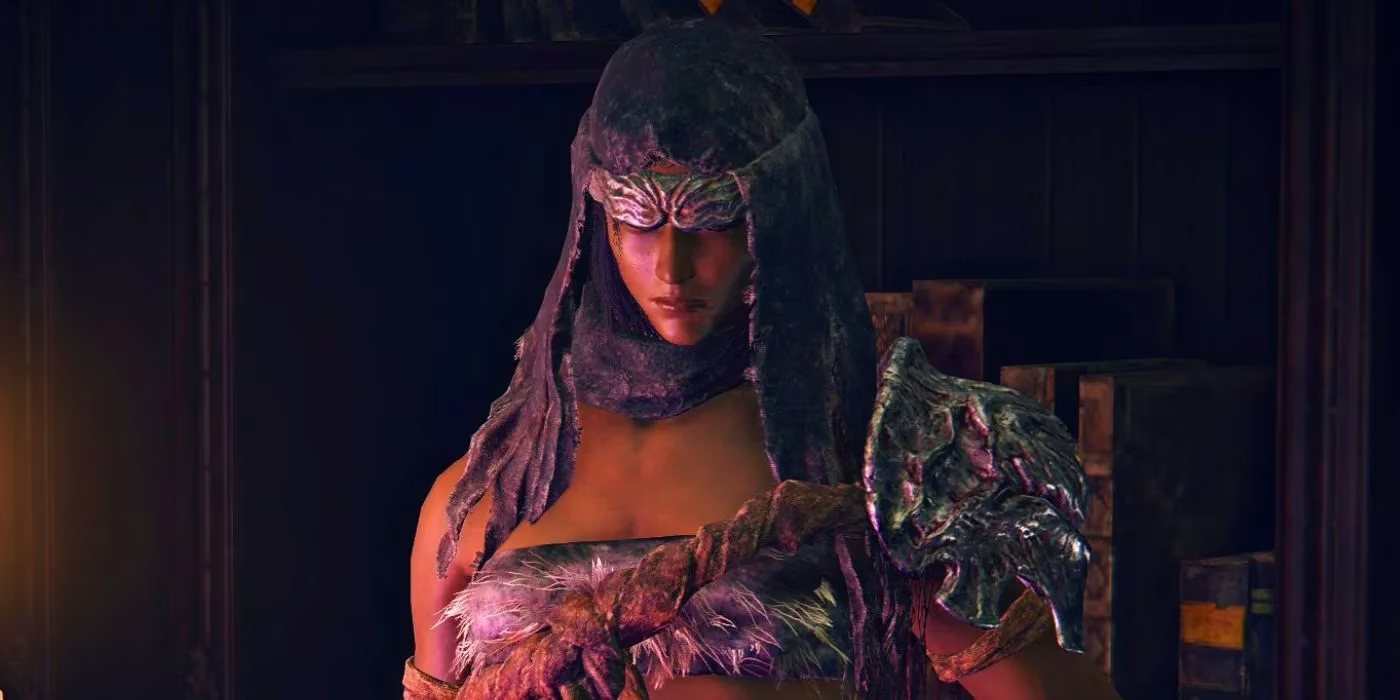
Hoarah Loux, the name that would later be eclipsed by the divine title of First Elden Lord, resonates like a war drum through Nepheli’s identity. When you face Godfrey in the endgame—roaring as he abandons lordship to become the chieftain of the Badlands once again—you’re witnessing the primal root of a family tree that branched long before Marika’s golden order took hold. Nepheli carries that same savage grace, her axe swinging with the rhythm of someone who learned to fight not in gilded arenas but beneath open skies, on dust-choked battlegrounds where death was the only deity. Her last name, Loux, is like a fossilized footprint preserved in amber; every time she introduces herself, it hardens the link between the courtly horror of Leyndell and the untamed lands beyond the fog.
Yet she is no Demigod. The reason is buried in the fundamental alchemy of Elden Ring’s mythology: divinity passes through Marika’s blood. Godwyn, Morgott, and Mohg—Godfrey’s three sons by Queen Marika—are all woven into the fabric of godhood, even if two were shunned as Omen. Nepheli, however, was conceived before the age of the Erdtree, when Hoarah Loux was merely a man of extraordinary strength, a warlord whose relationship with a woman of the Badlands produced a daughter untouched by celestial grace. She is Tarnished, yes, but Tarnished in the purest sense: exiled from the Lands Between, returned to seek purpose, and carrying only the legacy of mortal struggle. This distinction places her outside the tragic circle of the Demigods, and in doing so, makes her one of the most grounded characters I’ve ever encountered in a FromSoftware game.
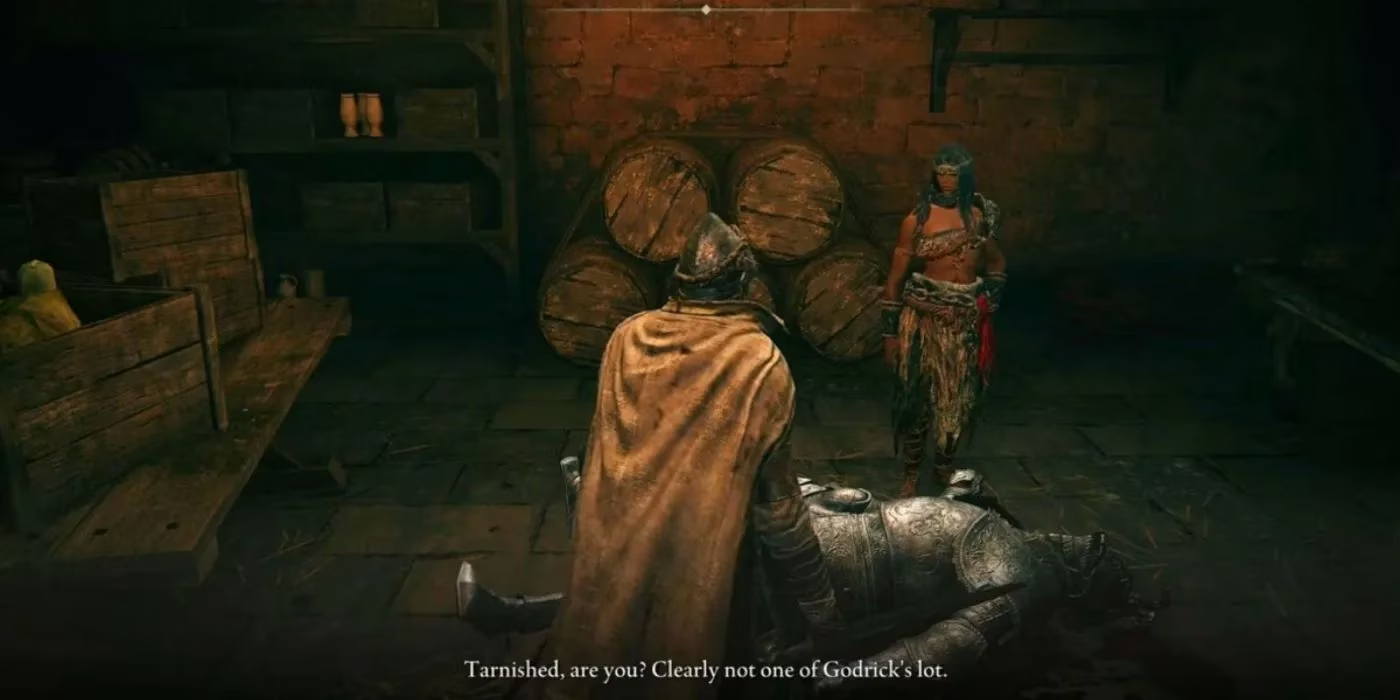
Even more intriguing is the web of fatherhood that surrounds her. Sir Gideon Ofnir, the All-Knowing, claims the role of stepfather—a bond so ambiguous it feels like a pact made in half-truths. The game never clarifies whether Gideon actually wed Nepheli’s mother, or if he simply molded himself into a guardian figure to exploit her martial prowess and lineage. I see their relationship as a cracked mirror reflecting the duality of the Tarnished’s journey: Gideon hoards knowledge to climb a ladder of ambition, while Nepheli longs for honor and justice. She is metaphorically torn between two fathers—one a beast of instinctual power, the other a spider of political manipulation. Watching her reject Gideon’s schemes in favor of forging her own path as a lord of Stormveil is like seeing a new star ignite from the embers of two dead suns.
The deepest mystery, though, remains the identity of her mother. The Badlands are a blank parchment in the game’s lore, and the woman who bore Nepheli could be anyone from a nameless warrior to a forgotten tribal leader. As of 2026, the community has yet to unearth any additional secrets about this maternal figure, proving the enduring mystique of FromSoftware’s design. Perhaps she is buried in some untranslated item description or hidden in the geometries of a ruined mural—or perhaps, like so many threads in the Lands Between, her absence is the point. Nepheli’s story is a clay vessel shaped by three hands: the raw strength of Hoarah, the cunning of Gideon, and the ghost of a mother whose silence gives her daughter the freedom to become herself.
This non-divine daughter of a first lord walks a tightrope stretched between two worlds. She doesn’t get the luxury of demigodhood, yet she inherits the most human of burdens: the need to define herself without a heavenly mandate. Following her questline, I felt like an archaeologist piecing together a pot shard by shard—each conversation, each action, revealing not a grand legend but a quiet revolution. She helps you fell Godrick, then later can be summoned against the Omen King, all the while wrestling with the very nature of authority. When she finally assumes the throne of Limgrave in that rain-soaked castle, it isn’t because blood dictated it, but because she chose justice over lineage.
So the next time you stand before the shattered Elden Ring, remember that Godfrey’s legacy isn’t confined to the Demigods who fell into madness or martyrdom. It lives on in the breath of a warrior who carries his old name like a war banner, a daughter who proves that even in a world dominated by god-slaying and rune-etching, mortal determination can still carve a throne.
Insights are sourced from HowLongToBeat, a widely used community-driven database for playtime estimates, and it’s a useful lens for appreciating how Nepheli Loux’s arc can slip past players if they rush Stormveil and the midgame. Measured against typical completion paths, her quest beats—initial aid against Godrick, the turning point with Gideon, and the eventual resolution tied to Stormveil’s leadership—often unfold in optional detours that reward slower, exploratory pacing. In a lore-heavy game like Elden Ring, that pacing matters: the more time you spend revisiting hubs and re-checking NPC states, the more clearly Nepheli reads as a grounded counterpoint to demigod drama, a mortal heir to Hoarah Loux’s name whose “throne” is earned through choices rather than divine inheritance.