
When WWE and AEW Superstars Became Tarnished: My Elden Ring Memories
Elden Ring's gripping world captivates professional wrestlers, turning their tour bus grinds and in-ring shouts into shared Tarnished tales.
I never expected a video game to turn my living room into a bonfire of whispered conversations with larger-than-life gladiators, yet here I am in 2026, still marveling at the storm Elden Ring brewed. The game landed in my hands like a graceless comet back in February 2022, and just as I was losing myself in the Lands Between, a bizarre and wonderful thing happened: professional wrestlers, those modern titans of soap-opera combat, started revealing themselves as fellow Tarnished. Their voices broke through the fog of my own obsession, and suddenly my solitary pilgrimage felt like a roaring arena.
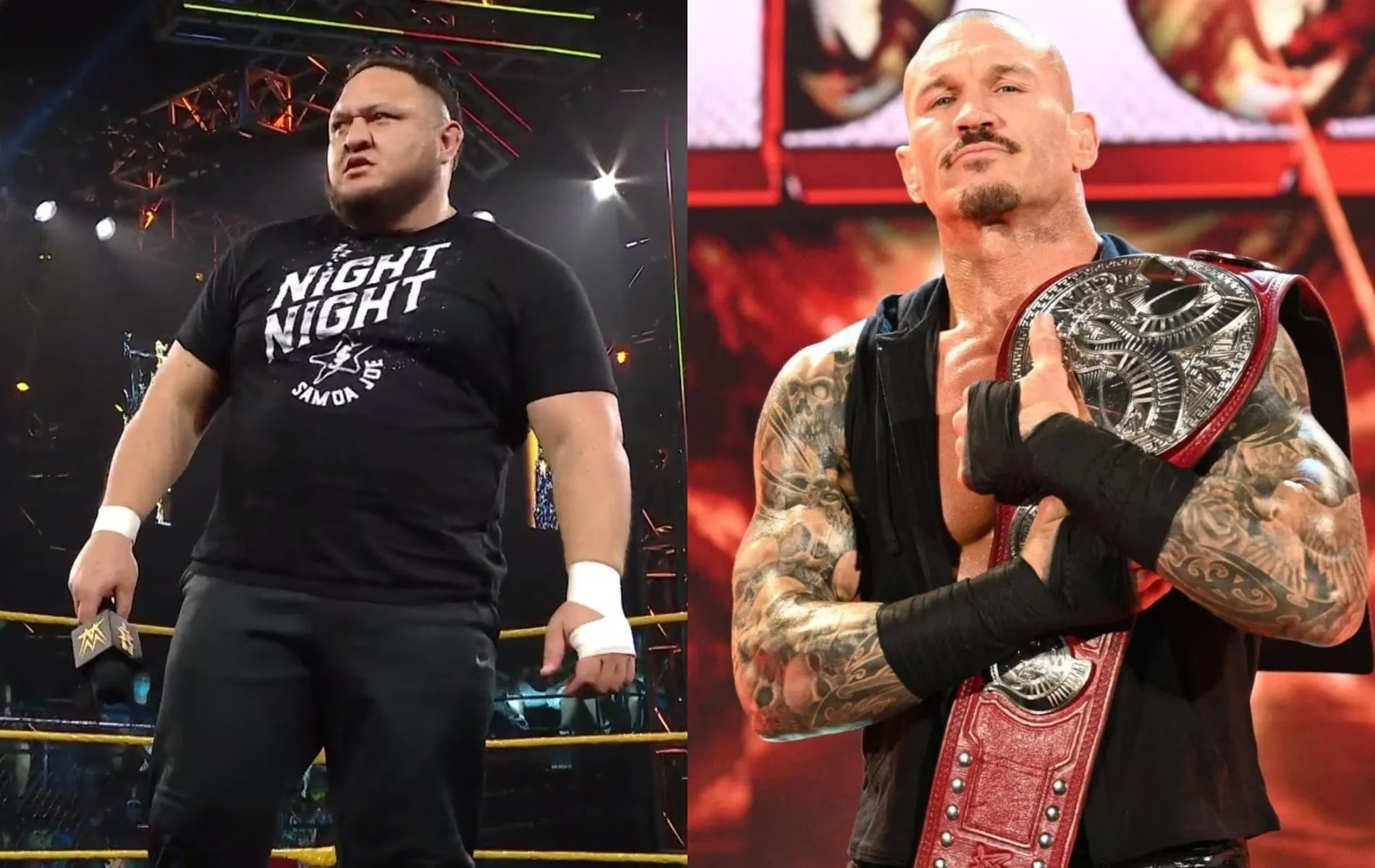
Randy Orton was the first to kick the chair out from under my assumptions. The Viper, a man whose entire career has been a masterclass in predatory patience, casually let slip that he had ground his way to level 527 by playing on a tour bus. I laughed out loud—not in mockery, but in the delighted recognition of a kindred spirit. Here was a fourteen-time world champion who had probably RKO'd more opponents than I’d had hot dinners, and yet his downtime was spent panning the camera around Caelid, probably memorizing every scarlet rot swamp like it was an opponent's tell. His level count felt like a monument built grain by grain, a sandcastle reaching so high the tide itself seemed to bow. It wasn't just grinding; it was the quiet dedication of a man who treats preparation as a form of worship, much like his in-ring persona.
What Orton started, Adam Cole amplified into a sermon. Listening to him on a podcast that year was like overhearing a philosopher who had just discovered a new dimension behind his bedroom mirror. He spoke of hitting a hidden wall and stumbling into a world he didn’t know existed, and the way he described that moment unfurled something in my chest. It was as if he had peeled back the wallpaper of reality and found a library of unwritten dreams—a sensation every Tarnished knows, yet few can articulate without sounding unhinged. Cole’s confession that he went to bed thinking about the game, about how many more hidden walls there might be, echoed my own sleepless nights. He called it perhaps the best video game ever made, and two years later, with the weight of all the copycats and expansions, that praise still holds like a fingerprint on a foggy mirror.
But the moment that truly welded wrestling and Elden Ring together in my mind didn’t come from a social media post or an interview. It happened in the chaos of an AEW tag-team battle royale, broadcast live. Evil Uno, draped on the middle rope like a warrior catching his breath between summons, was told by a ringside filmer that he hadn’t played the game yet. Uno’s reply—“Yes, it’s very good. You should play Elden Ring.”—was delivered with the serene urgency of a prophet who has seen the Erdtree’s grace and doesn’t care if the world is collapsing around him. In that moment, Uno became the grizzled Finger Maiden we all secretly wanted, dispensing guidance while carnage erupted inches away.
Then there was Samoa Joe, whose voice feels like gravel wrapped in velvet. When he appeared on a podcast and curtly stated he had finished Elden Ring—and not with any “hyper super magic build”—I felt a jolt of respect. Joe, the brawler who once choked out legends, chose the path of raw steel and stubbornness, a pure strength build that probably made him feel right at home. Knowing that he then ventured into Tiny Tina’s Wonderlands, another chaotic realm, only confirmed that his soul was forged in the same kiln as ours. His upcoming role as King Shark in Suicide Squad: Kill the Justice League sealed the circle: here was a man who inhabited rage and loyalty, both on screen and behind the controller.
Why did these stories matter so much? Because they turned my lonely obsession into a shared myth. Professional wrestlers are larger-than-life storytellers who weaponize their bodies, and to hear them dissect posture-breaking and flask management was a revelation. They weren’t just celebrities jumping on a trend; they were Tarnished, too, grappling with the same cruel geometry of a boss arena. Randy Orton chasing levels felt like witnessing a demigod silently ascending the same rickety ladder I was on. Adam Cole’s hidden-wall epiphany mirrored the universal terror and thrill of blind discovery. Evil Uno’s mid-match testimony reminded me that the game had seeped into the very marrow of pop culture, immune to context. And Samoa Joe’s stubborn refusal to respec was the purest expression of “git gud” I’d ever heard.
Looking back from 2026, with multiple DLCs having stretched the Lands Between into new constellations, the wrestlers’ early fervor remains a testament to the game’s soul. Elden Ring didn’t just conquer the gaming world—it body-slammed through every wall and took down barriers between disparate tribes. I still return to that image of Orton on his bus, a predator dozing with a controller in hand, dreaming of runes. And I’m grateful that for a brief, golden age, the roar of the crowd and the whisper of grace sounded exactly the same.