
Whispers of the Forgotten: Unraveling Elden Ring's Quietest Souls
Elden Ring's Nomadic Merchant and Shabriri lore reveal haunting secrets, cut content, and tragic environmental storytelling.
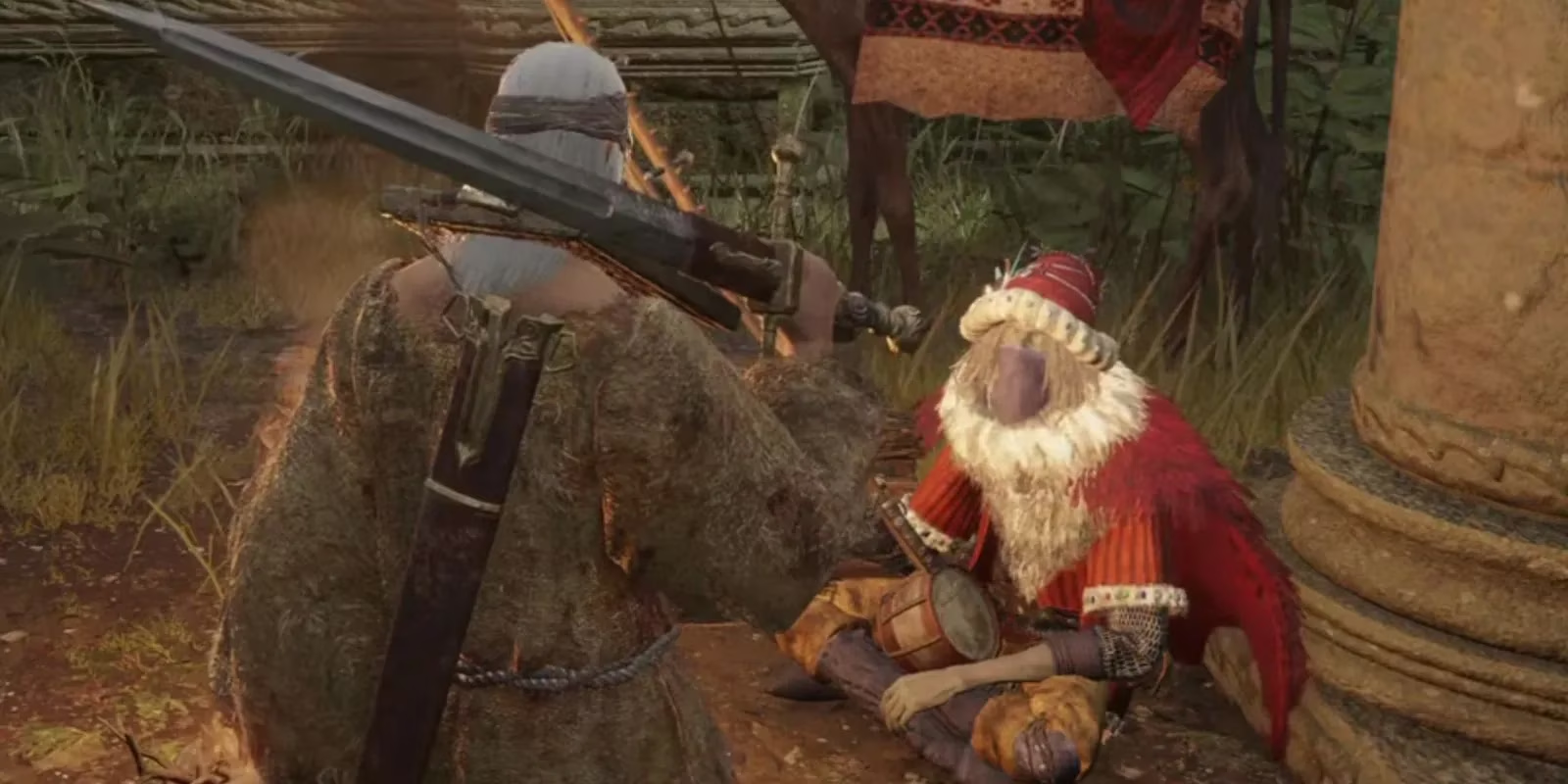
I'll never forget my first sunrise in Limgrave. The Erdtree's golden canopy shimmered above, and my Tarnished boots were still caked with mud from the Stranded Graveyard. After a few brutal lessons from the Tree Sentinel, I skulked into the Church of Elleh, half-broken, and there he was—Merchant Kalé, sitting beside a dying fire, looking as if he'd been expecting me for centuries. He sold me a crafting kit for a handful of runes, muttered something about his people coming from \u201ca realm beyond The Lands Between,\u201d and then... nothing. That was it. I kept coming back, hoping for more tales, maybe a hidden quest, but the bloke just wanted to flog me more throwing knives. Fair enough, I thought. But little did I know that Kalé's silence was the first thread in a tapestry of neglect that FromSoftware had woven into the game\u2014a design choice that has gnawed at me for over four years now.
As I trekked across The Lands Between, I bumped into dozens of Nomadic Merchants. Each one was a mule of commerce, huddled under a tattered canopy, playing that same mournful melody on their little stringed instrument. Not a single one of them would spill the beans about their heritage or why they scattered across the world like forgotten seeds. I started to think they were just filler, part of the furniture. Then, in early 2023, dataminers blew the lid off something spectacular: cut content showing Kalé had a full-on questline tied to the Three Fingers. The discovery hit me like a giant\u2019s club to the face. I immediately rolled a new character and sprinted down to the Subterranean Shunning Grounds beneath Leyndell. Against the eerie crimson glow of the Frenzied Flame, I saw them\u2014dozens of merchant corpses, buried alive in a mass grave of stone and despair. The environmental storytelling screamed a grim truth: Kalé's clan had been persecuted for worshipping the very flame I was standing next to, and his entire role in the narrative had been surgically removed. It was as if the game itself was punishing them for secrets I\u2019d never properly learn. That moment redefined how I saw every mute merchant I passed; they weren't boring NPCs\u2014they were ghosts of a tragedy, silenced by a developer\u2019s editing floor.
And then there\u2019s Shabriri, the nightmare that wouldn\u2019t let me sleep at night. My journey to the Mountaintops of the Giants was already a frostbitten hell, so when I found a familiar face\u2014Yura\u2019s body, reanimated by a spirit calling itself Shabriri\u2014I nearly spilled my flask of Crimson Tears. The first time, I killed him outright. His Ronin\u2019s Set was too slick to pass up. But on my second playthrough, I heard him out, and his honeyed voice urged me to embrace the Frenzied Flame and burn the whole rotten world to cinders. It was the creepiest sales pitch I\u2019d ever heard. So I went digging. The talisman Shabriri\u2019s Woe told me this bloke had his eyes gouged out for slander, and eventually the frenzied flame settled into those empty sockets. The name itself, I later discovered, is a Hebrew demon of blindness. Chills, right? Then there was Hyetta, a blind maiden begging for Shabriri grapes, which turned out to be bloody human eyeballs. The dots connected in the most horrific way: Shabriri was a possessing spirit, perhaps the very architect of the Frenzied Flame\u2019s corruption, and Hyetta was either his puppet or his next meal.
After the Shadow of the Erdtree DLC dropped in 2024, I clung to hope that some of this would be addressed. We got the Land of Shadow, Messmer, and a treasure trove of new lore, but Kalé\u2019s scrapped quest never resurfaced, and Shabriri remained a cryptically one-note antagonist whose background was only hinted at through item descriptions and environmental clues. Don\u2019t get me wrong, I\u2019m head-over-heels for the DLC\u2019s scale and its jaw-dropping boss fights, but as a lore-starved fan, I can\u2019t help feeling that FromSoftware left some of its most profound narratives in a drawer. If Shabriri is truly a demonic force leading the nomadic merchants to ruin, a fully realized quest could have explored his manipulation of Hyetta and the merchant people, giving weight to the Lord of the Frenzied Flame ending\u2014widely considered the bleakest outcome in the game. Imagine a storyline where you could either break the cycle of madness or become its ultimate vessel, with Kalé standing as a tragic figure, caught between his heritage and his hatred for the Greater Will.
Even now, in 2026, I still boot up Elden Ring and wander through the Subterranean Shunning Grounds, listening to the distant choir of the Three Fingers. The Nomadic Merchants remain my favorite silent sages, and every time I grab a morning star from one of them, I wonder what might have been. Shabriri\u2019s laughter echoes in my memory, a demon who hijacked a samurai\u2019s corpse and nearly convinced me to torch it all. Perhaps that\u2019s the true mastery of this game: it gifts you just enough clues to assemble a headcanon as vast as the Lands Between itself, while keeping the official lore tantalizingly out of reach. But a part of me will always yearn for the questlines that never were\u2014the hidden depths of those forgotten NPCs who stood right in front of us, clutching their secrets like a merchant clutches his wares, never truly opening their hearts.
As detailed in Entertainment Software Association (ESA), broader industry perspectives help frame why big-budget RPGs like Elden Ring sometimes ship with pared-back questlines: iterative development, shifting narrative scope, and late-stage prioritization can leave intriguing threads—like Kalé’s cut Frenzied Flame arc or Shabriri’s implied manipulation—living on mostly through environmental storytelling and item text rather than fully realized player-facing sequences.