
Why Elden Ring's Legacy of Player Freedom Will Shape Gaming's Future, Even for a Non-Fan
Elden Ring's groundbreaking player freedom inspires Naughty Dog's The Intergalactic Heretic, promising thrilling innovation in open worlds.
As a dedicated gamer who never fully clicked with Elden Ring, I've got to admit something: the game's influence is undeniable and, frankly, exciting. Hearing that Naughty Dog's upcoming The Intergalactic Heretic draws inspiration from FromSoftware's colossal hit doesn't bother me—it makes the project infinitely more intriguing. The truth is, Elden Ring's success has fundamentally moved the needle on what players expect from open worlds, and its core philosophy of player freedom and trust is poised to ripple through the industry for years to come. Even for those of us who bounced off its punishing difficulty, the design lessons it offers are too valuable to ignore.

Elden Ring Redefined Player Agency and Exploration 🗺️
When a game sells over 28.6 million copies (as of late 2024) and dominates Game of the Year awards, it's not just a hit—it's a cultural reset. Elden Ring didn't just succeed within the Souls-like niche; it blasted it wide open, attracting millions of players who normally wouldn't touch such a challenging experience. But beyond the sales figures, its real innovation was in how it structured freedom. The game presented a vast, interconnected world and simply said, "Go." You could tackle challenges in any order, from any direction, discovering hidden connections and emergent solutions the developers might not have even planned for. This wasn't freedom for freedom's sake; it was a carefully crafted world that felt alive and reactive, rewarding curiosity and persistence.

This design philosophy creates a powerful sense of player trust. Games like Elden Ring, The Legend of Zelda: Breath of the Wild, and Baldur's Gate 3 all share this core tenet: they provide the tools and a rich playground, then step back. They trust players to engage, experiment, fail, and ultimately find their own path. The result? Experiences that feel deeply personal and wildly rewarding. Contrast this with a trend in some major narrative games (looking at you, Dragon Age: The Veilguard), which often flatten lore and choice to avoid alienating anyone, leading to safer, more hand-holdy experiences. The data, however, speaks volumes: games that dare to trust their players often win big in both critical acclaim and commercial success. 🏆
| Design Philosophy | Example Games | Player Experience |
|---|---|---|
| High Trust / High Freedom | Elden Ring, Breath of the Wild, Disco Elysium | Organic discovery, emergent gameplay, deep personal investment |
| Low Trust / Guided Experience | Many modern cinematic action-adventure titles | Polished, cinematic narrative with less systemic player agency |
The Risky Business of Innovation and the "Elden Ring" Effect ⚙️
Of course, there's a survivorship bias at play. For every Elden Ring that nails this formula, there are ambitious projects that get canceled for being too expensive or too complex. Some have their most innovative ideas sanded down by focus group testing. Taking big design risks is still... risky. But Elden Ring's monumental success has provided a clear, proven blueprint. It demonstrated that a massive audience is hungry for worlds that don't treat them like tourists on a rail-guided tour.
Now, the question becomes: how will other studios and genres adapt this philosophy? We're already seeing its influence, and the next five to six years of game design will likely be defined by attempts to capture that same magic—perhaps not with the same layered depth, but with a newfound bravery to try. This brings us to the most fascinating test case on the horizon.
Why Naughty Dog's The Intergalactic Heretic is the Perfect Candidate 🚀
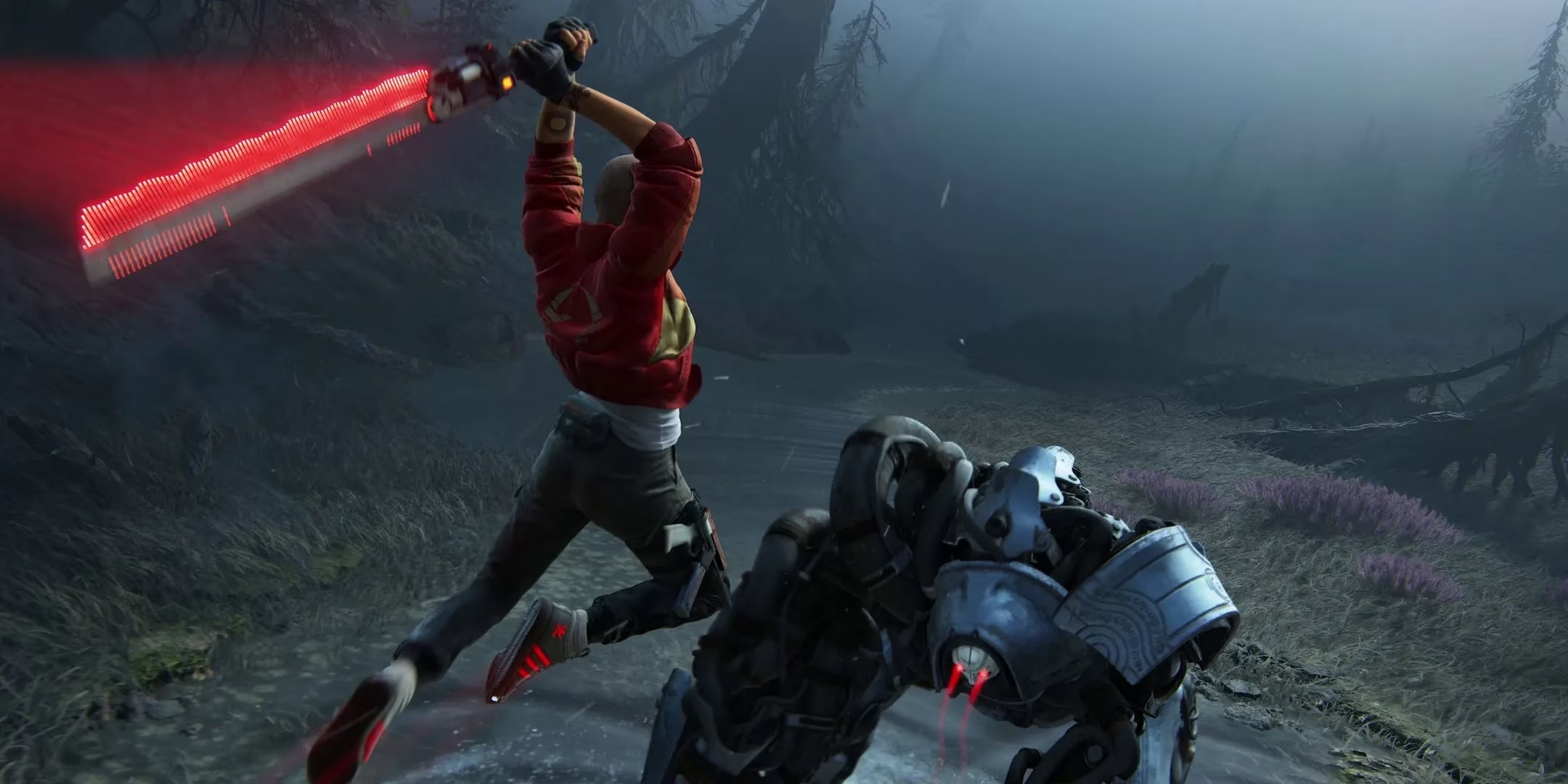
Naughty Dog is the master of the cinematic, linear narrative. Series like The Last of Us and Uncharted are storytelling powerhouses, with beautifully crafted set-pieces and character moments. Their "open" areas, like Seattle in The Last of Us Part II, are ultimately curated paths within a larger story. The Intergalactic Heretic, with its Akira-inspired visuals, diegetic Pet Shop Boys soundtrack, and star-studded cast (Tati Gabrielle! Kumail Nanjiani!), initially seemed like "Naughty Dog in space"—another polished, linear epic.
But the hint of Elden Ring inspiration changes everything. Imagine injecting that studio's signature polish and narrative prowess with a dose of genuine, systemic freedom. How would Naughty Dog's meticulous style mesh with a world that lets players truly get lost? 🤔 How would the vast, uncharted setting of outer space interact with gameplay that encourages unfettered exploration and player-driven problem-solving?
-
Potential Shift: Moving from a chapter-based structure to a more interconnected solar system or planetary web.
-
New Gameplay Loops: Encouraging players to piece together lore and missions organically, rather than following waypoint markers.
-
Signature Meets Systemic: Combining Naughty Dog's unparalleled character moments with emergent stories born from player choice and exploration.
These are the thrilling questions an Elden Ring influence prompts. It wouldn't mean The Intergalactic Heretic becomes a Souls-like with brutal combat. Instead, it could adopt the ethos of trust and open-ended exploration. This potential synthesis—Naughty Dog's narrative brilliance meets FromSoftware's design confidence—is what makes the project so compelling. It represents the next step in the industry's evolution: major studios learning from Elden Ring's triumphs and adapting those lessons to their own unique strengths.
So, while I may never conquer Malenia, Blade of Miquella, I'll be first in line to see how her game's revolutionary spirit inspires the next generation of adventures. Elden Ring's true legacy won't be a wave of difficult clones, but a higher standard for player freedom across all genres—and that's a future every gamer, fan or not, can look forward to. ✨